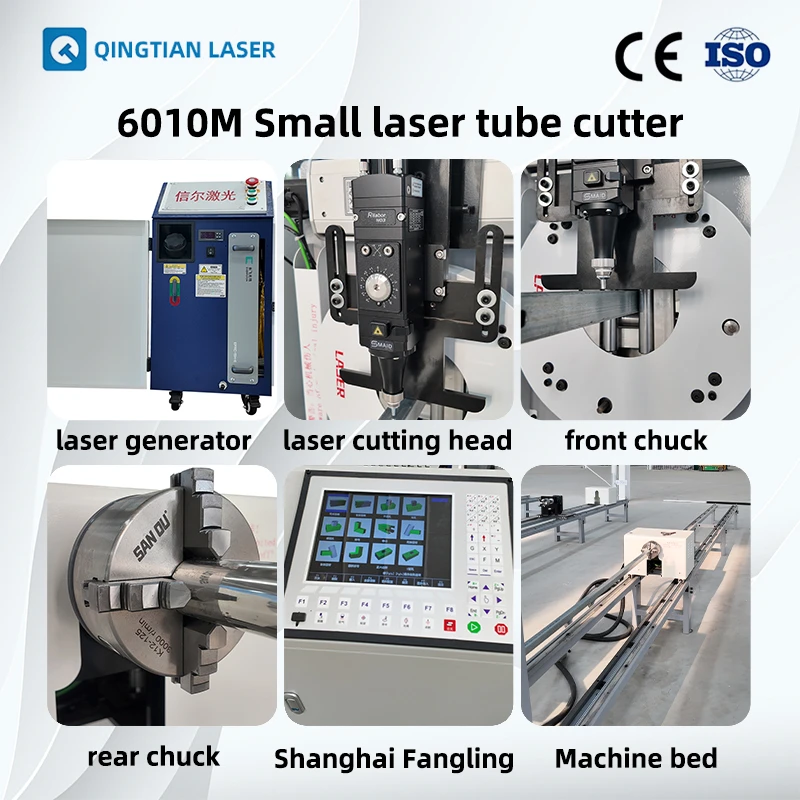
What is the QT-6010M: How does its three-section split design allow it to still work when moved to a construction site?
The QT-6010M is a portable integrated round-and-square small laser pipe cutting machine launched by Qingtian. It adopts two-axis linkage control and is equipped with a fiber laser, used for intersecting-line cutting and drilling of round pipes and square pipes. Its positioning is not to shrink a factory production line, but to allow pipe cutting to follow the work face.
The three-section split structure solves the handling problem, not installation-free operation.
The overall machine dimensions are 6600×500×1100mm, and moving the entire machine is not realistic. What the three-section split directly changes is the weight and volume of individual pieces, allowing passage through corridors, construction elevators, and narrow sites. However, splitting does not mean it can cut right after disassembly: after reassembly, the docking status of each section will affect cutting accuracy (nominal ±0.5mm), and accuracy self-inspection and trial-cut confirmation need to be carried out according to the procedure.
Two points are worth confirming before purchase: whether the approximate weight and dimensions of each single section after splitting match the on-site handling tools and passageways;Whether the manufacturer provides instructions for the alignment and calibration method after assembly. This determines whether, after being "movable," it can still "cut accurately."
What do the round-square tube compatibility and maintenance-free fiber laser each mean?
Round-square integrated means a single machine covers round tubes Φ12–114mm and square tubes 15–100mm, with thickness ≤4mm; it is relatively friendly for accessory factories doing mixed cutting of multiple specifications and for on-site tube modification, eliminating the need to equip a separate machine for square tubes;Tubes beyond this range fall outside its capability boundary.
"Maintenance-free fiber laser" is often misread as meaning the whole machine requires no upkeep. The accurate understanding is: this core component, the laser, is designed to reduce routine maintenance items, but the whole machine still has aspects that need attention—cleaning the cutting head lens, the status of the compressed air supply, cleaning and lubrication of guide rails and transmission components, and precision re-inspection after disassembly and assembly are all part of daily use. Treating "maintenance-free" as "zero upkeep" actually makes it easy for problems to appear first in dusty site environments.
Will the precision still be accurate after several disassemblies and reassemblies?First, follow these four steps for a post-restart self-check
Disassembly and reassembly itself will not cause the equipment to "most likely lose accuracy," but every transition is a state reset: whether the connectors have returned to their original positions, whether the gripper has been knocked out of alignment, and whether the optical path and cutting head have shifted during transport—these are the direct variables that affect cutting deviation. Therefore, the purpose of the post-restart self-check is not to prove that "the precision is definitely still ±0.5mm," but to confirm that the equipment is currently in a state where it can produce normally;If a deviation is found, first identify which link has not been reset, rather than rushing to doubt the capability of the entire machine.
Step 1: Appearance and connector reset inspection
Do not power on yet; start by checking the mechanical reset. After reassembling the three-section split structure, focus on three points: whether the mating surfaces between sections fit closely, whether all locking components are in place and tightened to the specified torque, and whether the cable and air pipe connectors are fully inserted and not pulled tight. Any loose connection will manifest as vibration or position drift during the cutting process, rather than an error that can be seen statically.
At the same time, check the cutting head and guide rail guards for signs of shipping impact; if any abnormality is found, address it first before proceeding.
Step 2: Visual and test-cut verification of gripper coaxiality
The gripper is the first checkpoint for coaxiality. Visual inspection: after the gripper closes, check whether the two jaw faces fit together in parallel, whether the clamping center is obviously offset from the chuck rotation center, and whether the pipe shows visible up-down or left-right runout after clamping. Visual inspection can only screen out obvious problems; real confirmation depends on a test cut—use a section of pipe with the same specifications as your daily processing, cut an intersecting line or drill a hole, and measure the deviation of the cut relative to the theoretical position.
How much deviation is considered normal? This depends on the tolerance requirements of your workpiece, not on a fixed number;Compare the measured values with the drawing tolerances; if they fall within the tolerance band, the part can be released. If they exceed it, go back and recheck the gripper and the mating surface. A single trial cut is not enough to demonstrate stability. It is recommended to cut 2 to 3 pieces consecutively to see whether the deviation converges.
Step 3 and Step 4: Trial Cut Records and Release Judgment
During the trial cut, simultaneously record the pipe specification, wall thickness, measured cut deviation, and appearance quality (dross, perpendicularity) to form a simple resumption-of-work record. If the deviation for several consecutive pieces of the same specification is stable and falls within tolerance, normal production can proceed;If the deviation increases piece by piece or fluctuates between large and small, it indicates that some connection link is still loose. Stop the machine and recheck rather than masking the problem by adjusting parameters. It should be noted that this self-check confirms that the "current state is usable." The precision retention after long-term repeated disassembly and assembly is related to the condition of the fasteners, the transportation method, and on-site conditions. Based on your specific relocation frequency and operating conditions, it is recommended to send the trial cut records to the QingTian team so they can determine whether further calibration or adjustment of the assembly method is needed.
Which scenarios are suitable for the QT-6010M, and in which situations is it not recommended?
To determine whether the QT-6010M is suitable, first look at two hard boundaries: pipe diameter and wall thickness. Round pipes Φ12–114mm, square pipes 15–100mm, wall thickness ≤4mm; within this range it can perform intersecting-line cutting and hole drilling, with a nominal accuracy of ±0.5mm. Beyond this range, it is not a problem that can be solved by adjusting parameters; rather, the equipment's capability itself does not cover it.
Suitable scenarios: pipe processing and mechanical parts cutting on construction sites
Temporary pipe modification on construction sites. During the installation of steel structures, guardrails, and supports, on-site dimensions often do not match the drawings, requiring on-the-spot pipe cutting and hole drilling. The QT-6010M can be split into three sections for transport; it can operate once connected to a 220V power supply and compressed air, eliminating the round trip of transporting pipes back to the factory and then back to the site.
For this type of work—"small quantity, multiple specifications, fast turnaround"—its value lies in moving the cutting process right next to the pipes.
Small-batch mixed cutting at machinery parts factories. Works with both round and square tubes; switching specifications on the same machine requires no model change;Cut quality is better than plasma, reducing subsequent grinding operations. Parts blanking commonly involves multiple specifications and small batches; the system comes with a built-in graphics library and requires no programming, so changeover costs are low when switching parts, making it suitable for this pace.
A quick self-check: are the tubes you have on handallwithin the range of round tube Φ12–114mm, square tube 15–100mm, and wall thickness within 4mm? If the answer is "yes," and your work is mainly on-site operation or small-batch mixed cutting, this machine's capability range matches your needs.
Not recommended scenarios: extremely thick walls, extremely large pipe diameters, and sites without power or air supply
Wall thickness exceeding 4mm or pipe diameter outside the range. This is not a matter of "cutting a little slower"; it is beyond the equipment's design limits. When encountering such orders, you need to confirm with the QingTian team whether there is a larger-specification solution, or consider outsourcing the processing; do not force-fit the existing parameters.
There is no 220V power supply or compressed air at the site. The equipment depends on these two to operate. Non-compliant temporary power at construction sites and air supply relying on temporarily rented air compressors will directly affect whether work can start.
Confirming power capacity and air supply stability before entering the site is easier than figuring things out after arrival.
The pipe length exceeds 6000mm. The effective pipe length is 6000mm. For oversized pipes, the clamping and cutting plan must be confirmed first; do not assume it can be cut by default.
Pursuing large-batch continuous production. The portable design prioritizes solving the problem of "cutting on site" and is not designed for high-cycle production lines. If your scenario involves a single specification and long-term continuous cutting, you should raise the capacity matching issue separately and discuss it with the manufacturer.
What to confirm next
Organize your actual pipe list (material, round pipe/square pipe, outer diameter, wall thickness, single length, batch size) and check each item against the above boundaries. For those within the range, you can further confirm the on-site power and air supply conditions;If there are out-of-scope items, directly explain the specific specifications to the QingTian team and confirm whether there is an alternative solution. Only after the boundaries are clear does it make sense to discuss handling and precision self-inspection.
Should we choose the QT-6010M or continue using plasma?How to determine the boundaries of maintenance and budget
Conclusion first: for pipes within round tube Φ12-114mm, square tube 15-100mm, and thickness ≤4mm, with 220V power and compressed air available on site, and if you want to reduce subsequent grinding man-hours, the QT-6010M is worth prioritizing for evaluation;If the pipes exceed this range or there is no power or air supply on site, then it is not recommended to choose it; instead, confirm outsourcing or larger-specification equipment. This is also something that must be thought through at the selection stage, beyond the QT-6010M precision self-inspection.
Cut quality and grinding man-hours: a qualitative comparison of laser versus plasma
Laser cut quality is superior to plasma, reducing subsequent grinding labor. This calculation should be based on actual grinding hours and rework volume, not just the equipment price difference. If orders are mainly thick-walled, large-diameter pipes, the added complexity of laser cannot bring corresponding returns, and continuing to use plasma or outsourcing is more cost-effective.
Who is more worry-free in daily maintenance: the boundary between maintenance-free fiber lasers and complete machine upkeep
Fiber lasers are maintenance-free, which reduces the burden of light source maintenance;however, lens cleaning, guide rail lubrication, and gripper calibration still need to be performed daily. The dryness and cleanliness of compressed air directly affect lens life, which is a maintenance boundary easily overlooked when comparing laser pipe cutting machines with plasma.
The budget should prioritize matching the order structure, avoid paying for large-diameter, high-power redundancy, reserve investment for wear parts and upkeep, and incorporate the subsequent grinding labor cost of the plasma solution into comprehensive consideration.
Frequently Asked Questions
When cutting thin-wall tubes below 4mm, does plasma really cost more labor time than laser? The cost lies in subsequent processing. Plasma cuts need grinding to remove dross and bevel repair, while laser cuts are cleaner, saving labor and rework time.
Fiber lasers are maintenance-free, so does that mean the whole machine needs no maintenance? No. The laser is maintenance-free, but lenses, guide rails, and grippers still need periodic inspection and cleaning.
Under what circumstances is it not worth increasing the budget for laser? When the pipe diameter and wall thickness exceed the equipment's capacity, there is no stable power and air supply on site, or the proportion of grinding man-hours is very low, the benefits of increasing complexity are limited.
Learn more
If you are evaluating the accuracy confirmation process for resuming work after relocation, or want to check whether the pipe specifications fall within the capability boundaries of the QT-6010M, you can send the pipe list (material, round pipe/square pipe, outer diameter, wall thickness, single length, batch) and the on-site power and air supply conditions to the Qingtian Smart Manufacturing team, and we will help determine the suitability based on this and provide specific recommendations for resumption self-inspection and assembly calibration.