The difference between semi-automatic chain loading and a fully automatic material warehouse lies in who does the work across "loading—feeding—clamping—receiving."
The gap is concentrated in the manual involvement and changeover adjustment in the loading and receiving stages, not in the laser cutting itself. In the three stages of feeding, clamping, and cutting, both semi-automatic chain loading and a fully automatic material warehouse can complete them automatically;what truly diverges is the first stage and the last stage—how the raw tube enters the machine and how the finished part leaves the machine.
Who completes each of the five processes under the three loading methods
| Process | Manual loading | Semi-automatic chain loading (QT-6012BL-3000W) | Fully automatic material storage |
| Loading | Manual tube-by-tube handling and alignment | Manually place the tube onto the chain rack; the chain feeds it in automatically | The storage automatically retrieves and feeds in the tube |
| Feeding | Manual pushing | Automatic | Automatic |
| Clamping | Manual alignment followed by chuck clamping | Automatic (chuck) | Automatic |
| Cutting | Automatic | Automatic | Automatic |
| Material receiving | Manual collection | Manual or simple receiving device cooperation | Automatic sorting and palletizing |
The semi-automatic chain loading replaces the manual labor of carrying and aligning pipes one by one; the cutting process can run continuously with reduced manual intervention;however, each time a new batch of material is loaded or a stack of finished parts is collected, human involvement is still required. It belongs to in-process automation and is not equivalent to full-line unmanned operation.
Why the gap lies not in the cutting head but in the loading and unloading section
All three methods can automatically complete feeding, clamping, and cutting; the difference lies only at the two ends: "how the pipe goes in" and "how the finished product comes out." For batch cutting of pipes, this directly determines how many people are needed to monitor the machine per shift and how long production stops when changing specifications; The QT-6012BL-3000W has a processing range of diameter/side length 10–120mm and length ≤6500mm; when the specification span is large, the changeover adjustment in the manual loading stage is more noticeable;The 50mm remnant reduces waste in long-pipe nesting, not manual loading and unloading labor.
When selecting a model, first count how many times material is changed per shift, how long each stop lasts, and whether there is a dedicated person for receiving material, then judge whether semi-automatic is sufficient.
How the QT-6012BL-3000W semi-automatic chain loading works: manual-assisted loading enables unattended cutting
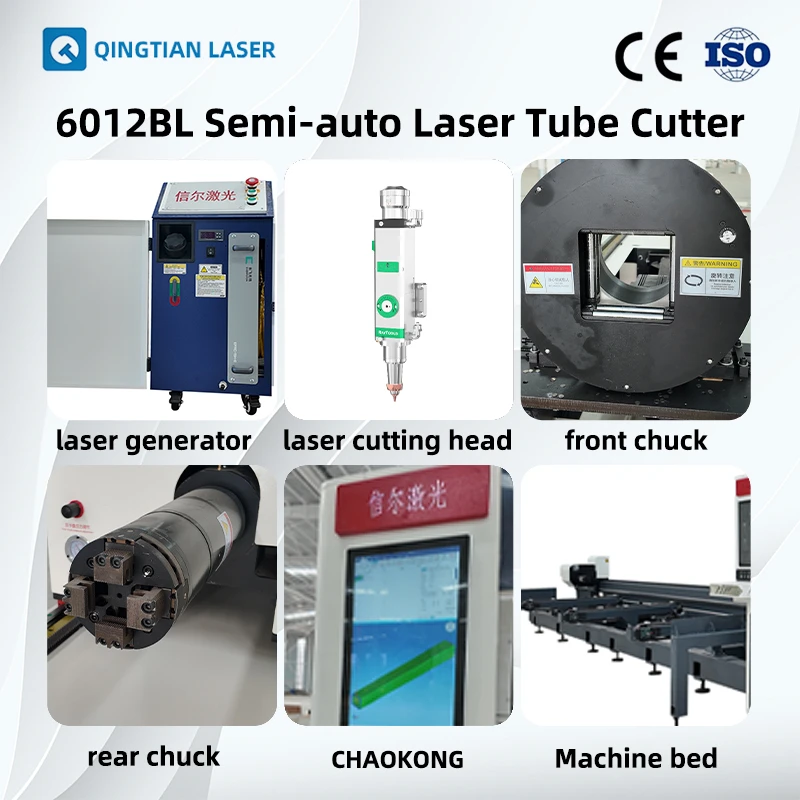
The "semi-automatic" aspect of this machine lies in the loading stage: an operator places bundles of tubes onto the chain loading rack, the chain feeds the tubes one by one into the chuck clamping area, and the subsequent cutting cycle is automatically executed by the CypCut control system according to the program. In other words, human actions are concentrated on material preparation before the batch starts and on replenishing the loading rack; during cutting, there is no need to hold each tube, set the tool, or unload material one by one, and the machine can continuously run through a nesting program—this is the practical meaning of "manual-assisted loading enables unattended cutting." What it eliminates is the repetitive physical labor beside the tube cutting machine, not the unmanned operation of the entire production line.
What problems do chain loading, the L-shaped bed with side-mounted chuck, and the CypCut control system each solve?
What chain loading solves iscycle consistency。 When loading material manually one piece at a time, the feeding speed, the seating of the tube, and the timing of the chuck clamping all follow the operator, and the longer the batch, the more pronounced the fluctuation becomes;The chain feeds at a fixed rhythm, the cycle time per piece tends to be stable, and it is easier to estimate how long a batch of material will take to run when scheduling production. The trade-off is that the loading rack has limited capacity, replenishing material still requires manual intervention, and when changing specifications, manual confirmation is also needed as to whether the tubes on the chain match.
The L-shaped bed plus side-mounted chuck solvesstructural stability and loading/unloading space during long tube processing。 The maximum tube length is 6500mm. If the bed adopts a conventional layout, the overhang of long tubes and the force on the chuck will directly affect the positional accuracy of the cutting end;The side-mounted layout moves the chuck out of the load-bearing path of the main bed, and the front chuck can also move out of the way, making short pieces and tail sections easier to handle. The official tail length is 50mm. X/Y-axis positioning accuracy of ±0.05mm and repeat positioning accuracy of ±0.03mm are the foundation for this type of structure to maintain cut consistency in batch cutting.
The Bosch Control system is responsible forprogrammatic execution: nesting, feeding, clamping, cutting, and unloading are linked in a set sequence, and the operator's job shifts from "following every tube" to "monitoring the program, replenishing material, and performing spot checks."
What do the 3000W laser and the 10–120mm tube diameter range indicate?
3000W determines how thick and how fast this machine can cut, but the specific tube thickness it can cut depends on the material, wall thickness, and cutting process; you cannot judge by the diameter number alone. The 10–120mm diameter/side length range indicates that it covers the specification band of common industrial tubes, furniture tubes, and automotive tube fittings;the larger the tube diameter and the thicker the wall, the more strained the 3000W's cutting speed and cuttable thickness become. When selecting a model, list the materials and wall thicknesses you cut most often, and ask the Qingtian team to confirm the cutting capability based on actual working conditions, rather than treating the maximum tube diameter as the capability limit.
To judge whether this machine suits you, the key lies in two points: whether your batch size is long enough to justify using chain loading in exchange for stable cycle times;whether your pipe specifications are concentrated in the 10–120mm range and lengths do not exceed 6500mm. If the incoming material specifications span a wide range and changeovers are frequent, or if you need warehouse-level fully automatic replenishment, semi-automatic chain loading will leave manual bottlenecks in the replenishment and changeover stages; in this case, you should submit your requirements to the Qingtian team to evaluate an upgrade plan.
Choose based on batch size and changeover frequency: under what circumstances to choose semi-automatic chain loading, and under what circumstances to adopt a fully automatic material warehouse
Conclusion first: if the daily cutting volume is several hundred pieces and changeovers do not exceed two or three times a day, a semi-automatic chain loading model such as the QT-6012BL-3000W is a reasonable choice;Only when "the changeover frequency is so high that manual material alignment becomes a bottleneck" or "the continuous operating time per shift is so long that a material warehouse buffer is needed" is it worth paying extra budget for a fully automatic material warehouse.
Decision tree based on daily cutting quantity and changeover frequency
Answer three questions in order, and stop at the first "yes":
- Do you change production more than 4–5 times a day, and each time you have to re-match materials and adjust specifications?
Yes → Manual material matching time will eat into capacity, and only then does the material sorting and production scheduling value of a fully automatic material warehouse truly become apparent. No → Proceed to Step 2.
- Does a single shift involve long periods of continuous cutting, where replenishing material midway interrupts the cycle?
Yes → Continuous material supply from the material warehouse is meaningful;No → Proceed to Step 3.
- Do you cut several hundred pieces per day, with relatively concentrated specifications?
Yes → Semi-automatic chain loading is sufficient. This machine's processing range covers diameter/side length 10–120mm and length ≤6500mm. With a 3000W laser and a Y-axis speed of 150m/min, the cycle-time bottleneck usually lies in material changing and nesting, not in cutting itself. Manual-assisted loading is enough to maintain continuous cutting, and the 50mm remnant is also friendlier for long-tube nesting.
For a few hundred pieces at this magnitude, semi-automatic capacity can keep up, provided the specifications are not fragmented and changeovers are not frequent. If you cut seven or eight specifications a day, a few dozen pieces each, the bottleneck is not the machine but the setup actions for each specification change—in this case, paying more for a loading magazine may not solve it; first confirm the changeover process itself.
Scenarios where adding automation complexity is not recommended
- Extremely fragmented specifications, a few dozen pieces per batch: The magazine's material-sorting logic is not easy for mixed multi-specification production lines, and the input-output ratio is poor.
- Poor incoming material consistency: The pipe diameter range is wide and there are many special-shaped pipes. Chain feeding and the material warehouse both depend on regular incoming material. Solve the incoming material issue first before discussing automation.
- Limited space and power: The whole machine is 24KW with dimensions of 8800×2900mm, and the fully automatic material warehouse requires additional floor space. If the factory has not reserved space, do not force it.
- Insufficient subsequent maintenance capability: More material warehouses mean additional material distribution and inspection steps, and fault points increase accordingly. Without stable maintenance manpower, a simple solution is more reliable.
Regarding whether it can be upgraded to fully automatic in the future: This depends on whether the interface between the material warehouse and the main machine matches. You cannot assume that "buying semi-automatic first and adding a material warehouse later will be enough." On this point, you need to confirm with the QingTian team whether this model has reserved upgrade interfaces and what modifications the upgrade involves, and then decide whether to reserve budget for the future.
Four things to check before implementation: pipe diameter and length, precision criteria, power supply layout and maintenance, and finally how to choose
The boundaries of this QT-6012BL-3000W semi-automatic loading laser tube cutting machine are fairly clear: pipe diameter/side length 10–120mm, single piece length ≤6500mm, workshop power supply 380V/50Hz. Check the following items before implementation, then discuss price and configuration.
How to check incoming material specifications, precision test conditions and 380V/50Hz power supply layout
Hard conditions that can be judged directly: If the incoming pipe diameter or side length exceeds 10–120mm, or the single piece length exceeds 6500mm, this machine does not match, and there is no need to continue the discussion;If the workshop does not have a 380V/50Hz power supply, resolve the power supply first before discussing the equipment. The L-shaped bed has an outline of approximately 8800×2900×2300mm, and space must also be reserved for the chain loading and unloading flow lines; if the site cannot accommodate it, it simply cannot.
Items to confirm with the manufacturer: Positioning accuracy ±0.05mm and repeat positioning accuracy ±0.03mm are equipment capability parameters; actual results are affected by incoming material straightness, clamping status, and cutting process. Test conditions must be noted, and the manufacturer's confirmation shall prevail. Whether square tubes, rectangular tubes, and oval tubes can be directly loaded onto the chain also requires bringing actual cross-sections for the manufacturer to confirm; if necessary, this may involve adjustments to material grippers or accessories.
Items that depend on working conditions: Maintenance of the chain loading mechanism mainly involves chain tensioning and lubrication, and the inspection interval follows dust and shift patterns—shorten it for two-shift operation and heavy dust; extend it for single-shift operation and clean incoming material. Please ask the manufacturer for recommendations based on the actual site.
Provide typical orders and shift patterns to QingTian for a cycle time evaluation.
Do not calculate cycle time yourself based on speed parameters. Organize tube diameter, wall thickness, single-piece length, pieces per shift, and material change frequency into typical orders, and provide them to the QingTian team for a cycle time evaluation. At the same time, ask clearly about the path and retrofit cost for subsequent upgrading to a fully automatic material warehouse.
How to make the final choice: If the incoming material specifications are within range, the power supply site is fine, and the main problems can be solved by semi-automatic chain loading, choose this semi-automatic loading laser tube cutting machine;If a more complete automated production line and long-term maintenance expectations are involved, then evaluate an upgrade, and do not blindly go fully automatic.
Frequently Asked Questions
Is a 50mm remnant a big waste over the long term? It depends on the order structure. If medium- and long-length tube parts are the main focus, the 50mm share after amortization is very small;When many short parts are nested, the impact will be amplified. It is recommended to take the main orders from the past few months and re-nest them once based on a 50mm remnant before making a judgment.
How should the chain feeding mechanism be maintained? Mainly chain tensioning and lubrication; the interval depends on dust and shift intensity. Having the manufacturer provide an inspection interval based on your site conditions is more reliable than applying generic recommendations.
Can my square tubes and oval tubes be fed directly onto the chain? The processing range covers 10–120mm, but the feeding adaptability for special-shaped tubes needs to be confirmed with the manufacturer using actual cross-sections, and may involve adjustments to the material grippers or accessories.
If I want to upgrade to fully automatic later, would buying semi-automatic now be a waste? It depends on whether manual feeding is truly the current bottleneck. Give your shift and piece-count data to QingTian for a cycle-time assessment, and ask about the upgrade path in advance before deciding which tier to start with.
Learn more
If you are evaluating the investment boundary between semi-automatic and fully automatic, you can organize the pipe diameter, wall thickness, single-piece length, pieces per shift, and changeover frequency and send them to us. The QingTian team will conduct a cycle-time assessment based on your typical orders and provide matching configuration recommendations.