In metal furniture tube processing, why are hole punching and cutting often split into two separate operations?
Tube components of metal furniture, such as chair legs, cross braces, and backrest frames, usually need both fixed-length cutting and hole punching on the tube wall—for installing screws, passing through connectors, and routing wires. On the drawings, these two tasks are processing on the same tube, but on the shop floor they often become two machines, two groups of people, and two setups.
The reason is not complicated: traditional saw machines can only handle "cutting off," while hole punching relies on drill presses, punch presses, or manual marking and positioning. Saw machines cut material quickly, but the cut end face has no reusable positioning reference;After the tube is cut and falls to the ground, is stacked, and then moved to the drill press, workers have to re-measure the length, find the angle, and mark and center-punch lines. Round tubes also roll, and although square tubes are somewhat easier to clamp, only one face can be processed per setup.
As a result, the process is naturally split into "cut all material to length first, then punch holes in a centralized step." It looks like a clear division of labor, but in reality every tube is clamped more than twice.
Where does the traditional process of sawing and manual hole drilling get stuck?
It gets stuck in three places, and none of them can be solved by workers just being more careful:
- Loss of datum: After sawing, the length is established, but the distance of the hole positions relative to the end face needs to be re-established.During batch production, the first piece relies on scribing, and subsequent pieces rely on stops or templates, so errors accumulate with each clamping.
- Limited angles and number of faces: Metal furniture tube parts often have angled cut ends and multiple hole faces.Manual hole drilling requires flipping the part and re-clamping, making hole spacing and phase angles prone to deviation, and mismatches are often only discovered during assembly.
- Takt time mismatch: The sawing machine produces a batch in a few minutes, but the drilling machine has to drill holes one by one.The upstream process piles up material, the downstream process chases goods, and work-in-progress accumulates more and more in between.
What outsourcing and turnover problems can be caused by dispersing multiple processes?
For small factories and self-employed individuals, the real cost of splitting processes is often not inside the workshop, but outside it:
- Outsourced hole drilling lengthens lead times: Without your own drill jig or punch press, sending hole drilling to an outside contractor means handing your lead time over to someone else's production schedule.Furniture orders are often rush orders with small batches and multiple specifications. With one round trip for outsourcing, profits are eaten up by freight and waiting.
- The number of turnovers directly turns into cost: Cutting—handling—hole punching—handling again—deburring—warehousing. Every turnover carries the risk of dents, mixing, and lost parts.Round tubes are especially prone to rolling apart, and once there are many specifications, you have to rely on labels and human memory.
- Quality responsibility gets fragmented: If the length is out of tolerance, find the sawing machine; if the hole position is off, find the hole punching; when final assembly fails, it is hard to trace which clamping operation caused it.Rework means going through the whole process again.
- Changeover time gets magnified: Furniture tube orders have mixed specifications—square tubes today, round tubes tomorrow.Separate processes mean that every time the specification changes, the saw and the drill each need to be adjusted once, doubling the number of changeovers.
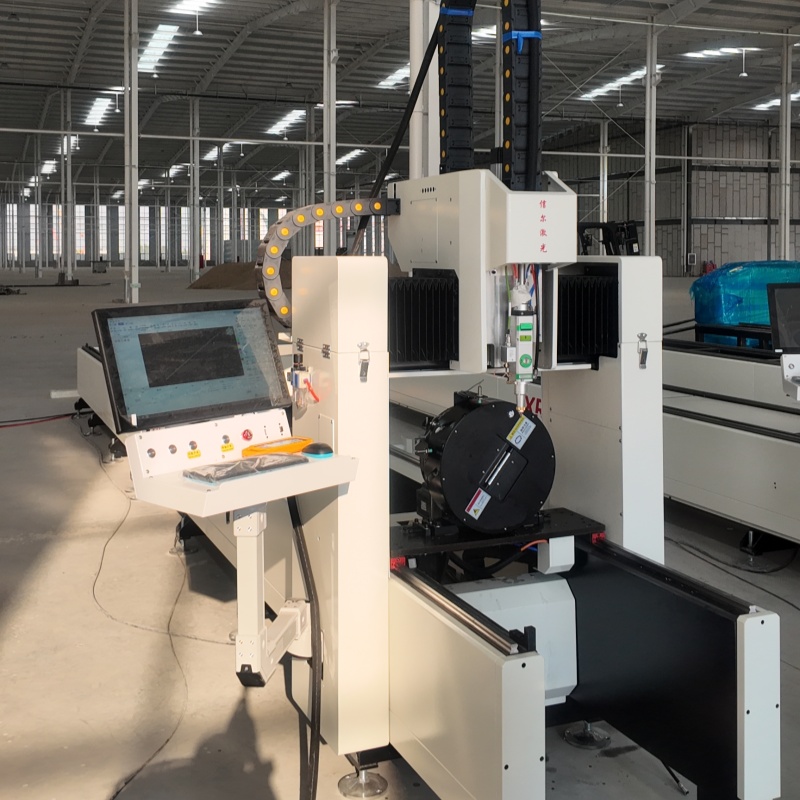
This is also why "whether hole cutting and cutting-off can be done on one machine" becomes a real question during selection: it is not about pursuing multi-function equipment, but about eliminating two setups, two transfers, and one outsourcing step. Take the QingTian mini economical fiber laser tube cutting machine: its positioning is 2D cutting, hole cutting, and cutting-off for small-diameter round tubes and square tubes, with a 1500 W, 4-axis configuration, covering a cutting thickness of 0–10 mm. Whether it can save you that separate process depends on whether your tube diameter range, hole position accuracy requirements, and batch rhythm fall within its suitable range—these conditions need to be confirmed item by item with the team, rather than just looking at the single statement of "whether it can cut."
What the mini economical fiber laser tube cutting machine is: how it puts hole cutting and cutting-off on one piece of equipment
The mini economical fiber laser tube cutting machine is a piece of equipment that uses a fiber laser to process tubes, configured with 4 axes, a laser power of 1500 W, and the ability to cut 0–10 mm thickness, suitable for materials such as steel, aluminum, stainless steel, and iron. Its positioning is to let small factories and individual operators use one machine to cover the common processing of small-diameter round tubes and square tubes.
What the three types of processing—2D cutting, hole cutting, and cutting-off—respectively refer to
- Two-dimensional cutting: Cutting shapes on the surface of the pipe according to the graphic contour, such as beveled ends and irregular notches.
- Hole drilling: Cutting round holes, square holes, or slotted holes in the pipe wall for passing screws and assembling connectors.
- Cutting off: Cutting long pipes to the required length with a smooth cut, facilitating subsequent welding or assembly.
These three types of processing can be performed on the same machine because the laser head follows a programmed path, and hole drilling and cutting off are simply different graphic paths, requiring no tool or mold changes. When a pipe fitting requires both mounting holes and fixed-length cutting, it can be completed in a single clamping, eliminating the error of secondary positioning.
What does the 4-axis configuration and Fangling control system mean for tube processing?
The 4 axes allow the tube to rotate and feed during cutting, so the laser head does not need to rotate around the tube, and multiple faces of round tubes and square tubes can be processed. The Fangling control system is responsible for reading graphic files and planning cutting paths;combined with the Raytools laser head and liquid cooling system, the equipment can support longer periods of continuous operation.
To judge whether it suits you, the key is to look at three points: whether the tubes are mainly concentrated in small-diameter round tubes and square tubes;whether the order requires hole drilling and cutting off to be completed at the same time;whether the site and budget can accommodate a more complete configuration than a single-function cutting machine. If you only need simple fixed-length cutting and never need hole drilling, a simpler cutting device is sufficient. Whether the specific pipe diameter, wall thickness, and hole pattern fall within the processing range, it is recommended to send the sample pipe specifications and drawings to the official team for confirmation.
What it means for metal furniture tube processing to combine hole punching and cutting into one machine
The processing pain point for metal furniture tubes is often not "can it be cut," but "after cutting, holes still need to be punched." The traditional approach is to use a saw for cutting and a drill or punch for hole making, requiring two setups and two positionings, with the tube fittings shuttling back and forth between machines and an additional accumulated error.
Putting hole punching and cutting on one machine changes three things: it eliminates the outsourcing and secondary machine loading for drilling or punching, and the tube fitting completes both types of processing in a single setup;It reduces the handling and queuing between saws, drilling machines, and outsourcing factories;The distance from the hole to the end face is more reliably controlled by the same clamping and control system, no longer relying on two manual tool alignments. For metal furniture tubes with small batches but diverse specifications, the value of this integration is more direct than simply increasing cutting speed.
Reduce outsourcing and turnaround: from multiple setups to completion in one pass
The cost of multiple setups is not just an extra process step; each additional setup introduces another positioning error and another queue wait. Once hole drilling and cutting are combined into one machine, the drilling step that previously required outsourcing can be brought back in-house, and the pipe fittings no longer need to be transferred across equipment or across factories. For metal furniture tube orders with many specifications and small batch sizes, the reduced turnaround time often affects delivery dates more than the cutting itself.
Judging the suitability of 1500 watts and 0-10mm thickness for metal furniture tubes
This mini economical fiber laser tube cutting machine has a 1500-watt, 4-axis configuration, a nominal cutting thickness of 0-10mm, and a cutting speed of 7000-8000mm/min. It is used for 2D cutting, hole drilling, and cutting off small-diameter round tubes and square tubes.
When judging suitability, do not look only at the upper limit of "0-10mm"; look at the actual wall thickness distribution: thin walls as the main type (common furniture tubes are 1-3mm) fall within the conventional range, with hole drilling and cutting off completed in one pass;Medium wall thickness (3-6mm) can still be processed, but the cutting speed will decrease as wall thickness increases. 7000-8000mm/min is the upper limit of the machine's capability and does not mean thick walls are also processed at this speed;Approaching 10mm falls into boundary operating conditions, and material, hole diameter size, and cross-section quality requirements need to be confirmed.
In terms of materials, the equipment is suitable for steel, aluminum, stainless steel, and iron. Stainless steel round tubes and square tubes have good adaptability in the thin-wall range;if orders are concentrated in thick-wall stainless steel with high hole density, it is recommended to first obtain actual tube samples for trial cutting. When the wall thickness remains above 8mm for a long time, the hole diameter is small and deep, and there are special requirements for cut surface roughness, it is recommended to first confirm process matching with QingTian.
Parameters not provided in the materials, such as the tube diameter range, also need to be confirmed with QingTian before judging whether they cover your commonly used specifications.
Which metal furniture tube processing scenarios are suitable for this equipment, and which situations require further confirmation
The core capability of this mini economical fiber laser tube cutting machine (1500W, 4-axis, 0-10mm cutting thickness) is: two-dimensional cutting, hole opening, and cutting off of small-diameter round tubes and square tubes. To judge whether it is suitable, the key is whether your pipe diameter, wall thickness, processing dimensions, and order structure fall within this range.
Recommended for: metal furniture pipe orders with small batches, multiple specifications, and hole punching plus cutting
The following scenarios have a high degree of match with the equipment's capabilities:
- Metal furniture pipe processing: table and chair legs, bed frames, shelving, etc., which require punching holes in the pipe and then cutting. This is typical two-dimensional processing, and this machine can complete punching and cutting in a single clamping.
- Guardrail post cutting: batch cutting, requiring flat cuts and consistent lengths, which belongs to small-diameter pipe cutting processing.
- Stainless steel round pipe and square pipe cuttingFor orders with many specifications, small batches, and frequent changeovers, the 4-axis configuration and graphics format support facilitate rapid switching.
- Advertising frame fabricationPipe specifications are diverse, with many single-piece customizations, requiring flexible and fast cutting response.
The common characteristics are: pipe diameter is not large, wall thickness is within 0-10mm, only two-dimensional cutting is required (hole opening + cutting off), and orders are mainly multi-specification small batches. These users are usually individual hardware processing operators, small metal product factories, or just-starting pipe processing entrepreneurs, with limited budget and space, hoping one machine can cover a variety of small-diameter pipe work.
Who is not recommended to use it: scenarios exceeding 0-10mm thickness or requiring three-dimensional processing
In the following situations, it is recommended not to make a decision based on this machine for now:
- Wall thickness exceeding 10mm: Beyond the nominal cutting thickness range, neither the cutting capability nor the cross-section quality can be more reliably guaranteed.
- Requires 3D machining: For example, bevel cutting, groove cutting, intersecting line cutting, etc. This equipment performs 2D cutting positioning and cannot cover these.
- Mainly large-diameter pipes: The equipment is positioned for small-diameter round pipes and square pipes. The clamping and cutting range for large-diameter pipes needs to be confirmed separately.
- Ultra-long pipes or heavy-duty pipes: This involves loading length, load-bearing capacity, and bed structure, which are unknown factors.
These scenarios cannot be solved by simply "paying more for an upgrade"; rather, they require a different type of equipment. If your orders are mainly three-dimensional cutting or thick-walled large-diameter work, you need a different type of equipment rather than agonizing over the configuration of this machine.
Unknown items that need to be confirmed with QingTian before making a decision
The following items are not clear in the existing information, but they will directly affect your judgment. It is recommended to ask about each one clearly during consultation:
- Maximum cuttable pipe diameter and maximum loading length—This determines how large a pipe order you can take on.
- Actual cutting speed and cross-section quality under different wall thicknesses—7000-8000mm/min is the nominal cutting speed, and the actual value will vary with material and wall thickness.
- Whether special-shaped pipes other than square pipes and round pipes are supported——such as oval tubes and D-shaped tubes.
- Installation and commissioning, operation training, and after-sales response methods——especially important for users who are just entering the industry.
- Laser lifespan and daily maintenance costs——affects long-term operating cost accounting.
Organize the typical pipe specifications on your side (material, diameter, wall thickness, length) and the processing drawings, and send them directly to the QingTian team so they can give a matching assessment based on your actual workpieces. This is more reliable than just looking at parameter tables.
Frequently Asked Questions
Q: Is this equipment suitable for cutting guardrail posts? If the column is a round pipe or square pipe, with a wall thickness within 0-10mm, and only fixed-length cutting is required, it is a matching scenario. However, if the column diameter is relatively large, it is necessary to first confirm whether the maximum cuttable pipe diameter covers it.
Q: For metal furniture pipes that need both hole drilling and cutting, can one machine complete both? Yes. The equipment supports 2D cutting, hole drilling, and cutting. Hole drilling and cutting on the same pipe can be completed in a single processing flow without changing equipment.
Q: The wall thickness is exactly 10mm. Can it cut stably? 10mm is the nominal upper limit. Whether stable cutting is actually possible and what the cut surface quality will be depend on the material and specific working conditions. It is recommended to use your actual pipe to have QingTian perform a cutting verification, rather than drawing conclusions based only on the upper limit value.
Q: I mainly make advertising frames, and the tube specifications change frequently. Is changeover troublesome? The equipment supports multiple graphic formats, and the 4-axis configuration is relatively friendly for switching between multiple specifications. However, for the specific changeover time and fixture compatibility range, it is recommended to confirm with QingTian whether the several specifications you commonly work with can all be quickly clamped.
Learn more
If you are processing metal furniture tubes, guardrail posts, or advertising frames and want to determine whether this mini economical fiber laser tube cutting machine matches your order structure, you can organize the material, diameter, wall thickness, length, and typical hole-position drawings of the tubes you commonly use and send them to the QingTian team.They will give a compatibility assessment based on your actual workpieces and help you calculate clearly how much outsourcing and turnover can be saved by combining hole cutting and cutting-off.