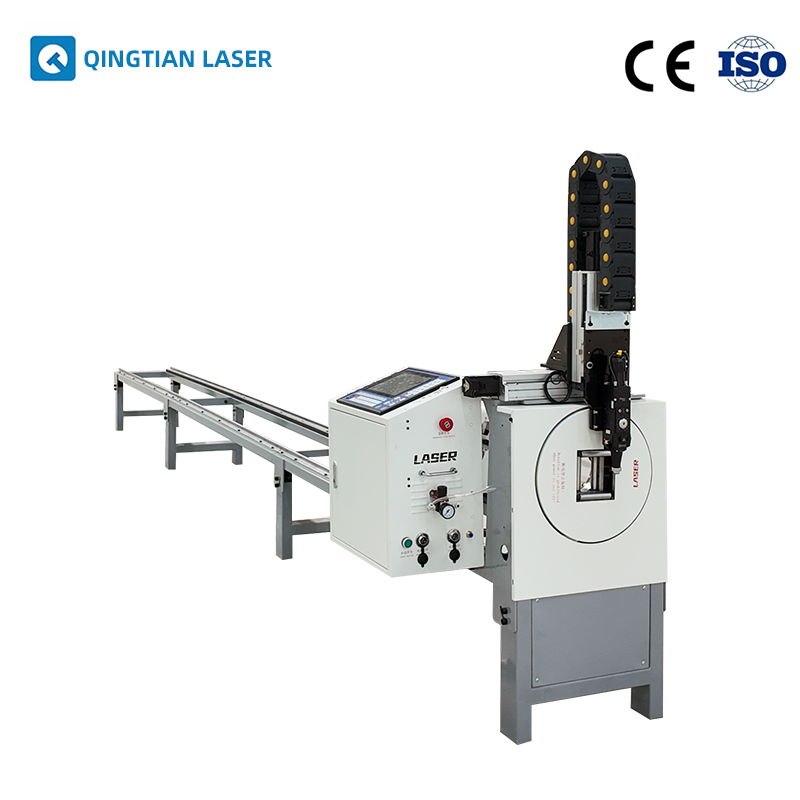
Mixed cutting of stainless steel, aluminum, and iron pipes—can this mini pipe cutting machine actually do it?
Yes. This QingTian mini economical fiber laser pipe cutting machine covers steel, aluminum, metal, stainless steel, and iron as applicable materials, equipped with a 1500-watt fiber laser and 4 axes, and is designed for 2D cutting, hole opening, and truncation of small-diameter round pipes and square pipes. So mixed cutting of stainless steel, aluminum, and iron is not a question of "whether it can be done," but rather a question of "under what conditions it can be cut stably."
List of applicable materials: what processing each of steel, aluminum, metal, stainless steel, and iron corresponds to
- Stainless steel pipes: Common material for guardrail posts, metal furniture, and advertising frames. The cut cross-section must be clean with minimal dross, making this the main application scenario for this equipment.
- Iron pipes (carbon steel): The easiest category to cut; blanking, truncating, and hole-making are all routine, and batch consistency mainly depends on whether feeding and clamping are stable.
- Aluminum tube: It is also within the applicable material list, but aluminum conducts heat quickly and reflects strongly, so it is more sensitive to parameters when cutting thin walls; the actual result needs to be confirmed according to your tube diameter and wall thickness.
- Steel and metal: It belongs to the general category within the same material list, and the specific processing method is still mainly two-dimensional cutting such as truncating and hole-making.
The difference among the three is not whether they can be cut, but that when switching on the same machine, parameters such as power, speed, and focus must be adjusted according to the material and thickness.
Prerequisite for judging the feasibility of mixed cutting: thickness and tube type must first fall within the capability range
This machine's nominal cutting thickness is 0–10mm, but this is the upper limit range of the equipment's capability, and it does not mean that any material or any wall thickness can be cut with the same cross-section quality. To determine whether your mixed-cutting requirement is feasible, first look at two things:
- Tube type: whether it falls within the category of small-diameter round tubes or square tubes.This is its design and processing scope; special-shaped tubes and large-diameter tubes are not included.
- Wall thickness: stainless steel, iron, and aluminum do not have the same cuttability at the same thickness, and the parameter requirements for thin-walled aluminum tubes and thick-walled stainless steel tubes differ significantly.
If your order involves "stainless steel, aluminum, and iron being fed onto the machine alternately within the same batch of material," the equipment itself supports this, but you must accept that every time the material is changed, parameters need to be readjusted and test cuts confirmed, rather than cutting from start to finish with a single program.
As for whether your specific combination of tube diameter and wall thickness can achieve stable mixed cutting, it is recommended that you provide the list of frequently cut materials and specifications to the QingTian team to confirm a parameter matching plan, rather than placing an order based only on the line "applicable materials."
When switching materials, which parameters truly need to be reconfirmed?
Many operators' first reaction when changing materials is "just adjust the program," but the actual logic of a fiber laser tube cutting machine is: the program only determines the graphics and path; what truly determines whether it can cut through and whether the cut surface is usable are the physical conditions matched to the material—power, speed, gas pressure, and focus. Changing materials is equivalent to changing a whole set of heat input conditions; the program can be reused, but the parameters cannot be copied directly.
1500W power and 0-10mm thickness: after switching materials, you still have to return to this boundary
1500W paired with 0-10mm—the decision-making implication of this combination is: it covers conventional wall thickness processing for small-diameter round tubes and square tubes, not "any material, any thickness can be cut." Different materials vary greatly in laser absorption rate, thermal conductivity, and melting point. At the same power and thickness, the actual cutting difficulty of stainless steel, aluminum, and iron is not at the same level. Aluminum has fast thermal conductivity and high reflectivity, and usually consumes more power than stainless steel of the same thickness;Iron is relatively easier to cut, but that does not mean you can arbitrarily push the thickness to the upper limit.
So after switching materials, what needs to be reconfirmed is:Whether the actual wall thickness of the current material still falls within the range that 1500 watts can stably cut through。 If cutting thin stainless steel tubes was originally very smooth, but after switching to aluminum tubes, incomplete cuts or dross appear, it is often not an equipment failure, but rather that the material has changed and the power boundary has not been rechecked. In this situation, the material, wall thickness, and tube diameter need to be provided together to the QingTian team to confirm a parameter matching plan, rather than repeatedly testing on your own until scrap parts pile up.
The 7000-8000mm/min speed is a reference range, not a fixed value for every material
The speed value of 7000-8000mm/min is easily misinterpreted as "once set, it can just run." It is more like a reference range under a specific material and specific thickness. After changing materials, the speed usually needs to be readjusted together with power and air pressure: cutting aluminum often requires reducing speed or increasing air pressure to improve the cut, and the speed windows for cutting stainless steel and iron are also different.
If the speed is too fast, the cut will not go through; if it is too slow, the heat-affected zone will become larger, the cut will turn yellow, and it may even burn through.
In actual operation, it is recommended to follow the sequence of "first confirm the material and wall thickness → then set the power level → then test the speed and air pressure → finally fine-tune the focus," rather than changing only one speed value. Every time you change materials, it is worth using a small piece of leftover material of the same specification for a test cut, and only after confirming the cut quality and dross condition should you move on to batch parts. This is also why this equipment is suitable for small-batch, multi-specification orders—it is flexible for changeovers, but only if you are willing to spend a few minutes confirming the parameters.
If you frequently switch back and forth among three materials, what you really need to think through in advance is: whether your orders are mainly based on a fixed set of specifications. The more concentrated the specifications are, the easier it is to lock in the parameters, and the lower the changeover cost;if the material, wall thickness, and pipe diameter are different every time, then you have to accept the pace of test cutting and confirmation for every order. This trade-off affects daily efficiency more than simply looking at whether it "can cut."
Which real processing scenarios are suitable for mixed cutting, and in which situations is it not recommended to force it?
This mini economical fiber laser tube cutting machine is used for 2D cutting, hole opening, and cutoff processing of small-diameter round tubes and square tubes. To judge whether an order can be handled, the key is whether the tube diameter falls within the small-diameter range, whether the material is within steel/aluminum/stainless steel/iron, and whether the wall thickness is within 0–10mm.
Four types of scenarios suitable for mixed cutting: stainless steel round tube and square tube cutting, guardrail post blanking, metal furniture tube processing, advertising frame fabrication
- Stainless steel round tube and square tube cutting: many specifications and small batches require frequent changeovers; the equipment supports multiple metal materials and offers flexible changeovers.
- Guardrail post blanking: this is batch cutoff of small-diameter tubes, requiring consistent lengths and flat cuts, with simple motions and high repeatability.
- Metal furniture tube processing: It often requires cutting and hole drilling. The equipment supports 2D cutting, hole drilling, and cutting, which can reduce the number of setups.
- Advertising frame fabrication: There are many one-off custom pieces and the tube specifications are varied, so a machine that can cover a wide range of small-diameter tubes is needed for quick response.
The common points of these four scenarios: the tube diameter is not large, the material is within the applicable range, and orders are mainly multi-specification and small-batch.
Signals that direct mixed cutting is not recommended: ultra-thick, special alloys, or diameters beyond the small-diameter range
- Wall thickness exceeding 0–10mm: The equipment cutting thickness is 0–10mm. Tubes outside this range are not recommended for direct processing.
- Materials beyond steel, aluminum, metal, stainless steel, iron: Copper, titanium, and other special alloys are not within the list of applicable materials. Whether they can be cut stably must first be confirmed with QingTian.
- Diameter beyond the range of small-diameter round pipes and square tubes: This equipment is designed for small-diameter pipes. Pipes with significantly larger diameters are not within the applicable range, and forcing operation will affect cutting results and equipment condition.
Take the most typical batch of orders on hand and check them against the three items: pipe diameter, wall thickness, and material. If all three items match, this equipment is worth further confirmation;If one item clearly exceeds the range, first report the specific pipe diameter, wall thickness, and material to QingTian to confirm whether a customized or alternative solution can be matched, and then decide whether to proceed.
Is it worth using this equipment for mixed cutting of multiple materials?Draw conclusions based on budget and order structure
The core value of this mini economical fiber laser tube cutting machine is not "how thick it can cut," but "how fast it can switch." 1500 watts, 0-10mm, 4-axis, liquid-cooled continuous operation, corresponding to two-dimensional cutting, hole opening, and cutting off of small-diameter round tubes and square tubes. To judge whether it is worth it, look at only two things: whether your orders frequently switch back and forth between steel, aluminum, stainless steel, and iron;whether your single batch quantity is so small that changeover time is longer than cutting time.
Who it is recommended for: processors with diverse order materials, small batches, and thickness within 0-10mm
- For work such as guardrail posts, metal furniture, and advertising frames, specifications are varied, with single batches of dozens to hundreds of pieces, cutting stainless steel round tubes today and aluminum square tubes tomorrow.A saw machine requires stopping for each material change and angle adjustment, while manual cutting cannot cut evenly and makes hole opening even harder.Switching materials on a laser tube cutting machine mainly involves changing process parameters, not tools, so changeover costs are low—this is its core advantage over saws and manual work.
- Entrepreneurs with limited startup capital and space who want one machine to cover multiple small-diameter tube types also fall within this scope.The liquid cooling system supports long periods of continuous operation, making it suitable for a model with irregular order intake where work is done in concentrated bursts.
- Budget judgment logic: if your work can steadily cover the equipment investment within six months to a year, and previously relying on outsourcing or manual work caused repeated problems with delivery times and precision, this machine's numbers add up.
Who it is not recommended for: scenarios involving long-term cutting of ultra-thick or single-material large batches, and where stable outsourcing already exists.
- Long-term cutting of thick-walled tubes above 10mm exceeds this machine's cutting thickness range; this is not something parameter adjustments can solve—it is a case of choosing the wrong tool.
- For single-material, single-spec, large-batch long orders, the saw's unit cost is lower, the laser's speed advantage is diluted, and the extra money spent does not buy a corresponding efficiency gain.
- In scenarios where stable outsourcing already exists and both delivery times and quality are under control, adding a machine means adding space, consumables, maintenance, and labor; complexity goes up, but the benefits may not keep pace.Mixed cutting itself also comes at a cost: different materials respond differently to power, air pressure, focus, and cutting speed. The process windows for aluminum and stainless steel differ significantly, and operators need to accumulate parameter experience—it is not something you can switch between mindlessly right after purchase.If the order volume cannot support this learning cost, mixed cutting becomes a burden.
Conclusion boundaries: If order materials frequently switch among steel, aluminum, stainless steel, and iron, thickness falls within 0-10mm, batch sizes are relatively small, and delivery deadlines are tight—get this machine. For long-term ultra-thick materials, single-material large batches, and stable outsourcing—do not get it. If you are somewhere in between, first calculate how much you lose each month due to changeovers and precision rework, then decide.
Frequently asked questions
Q: I mainly cut stainless steel and occasionally cut aluminum. Does that count as "multi-material mixed cutting"? Calculate. Occasionally cutting aluminum, on the contrary, tests switching convenience even more, because the frequency is low and the parameters are easy to forget.
It is recommended to record the parameters of commonly used materials in a file to reduce waste from trial cutting each time.
Q: This equipment can cut 10mm, so can it handle both thick pipes and thin pipes? 0-10mm is the coverage range, and it does not mean that every material can be easily cut up to the upper limit. High-speed cutting of thin tubes and low-speed cutting of thick tubes have different process requirements; the specific matching schemes for materials and wall thicknesses need to be confirmed with the team.
Question: Will mixed cutting consume the laser heavily and result in high maintenance costs? Fiber lasers have high electro-optical conversion efficiency and are generally characterized by being adjustment-free and maintenance-free, but their actual lifespan and maintenance costs depend on usage intensity, cutting materials, and routine upkeep; it is recommended to directly ask the team to clarify the warranty coverage and the replacement cycle for wear parts.
Q: I'm currently using a saw machine. Is it cost-effective to switch to this one? It depends on your order structure. If you have mixed specifications, small batches, and need to cut holes, switch;for single-specification, large-volume, long-term orders, a saw machine is more economical.
Learn more
If the pipes you frequently cut switch between steel, aluminum, stainless steel, and iron, with wall thicknesses ranging from 0-10mm, and the pipe types are mainly small-diameter round pipes and square pipes, you can compile a list of commonly used materials, pipe diameters, and wall thicknesses and send it to the Qingtian Smart Manufacturing team.We will combine it with your order structure to help you confirm the parameter matching plan and applicable boundaries of this mini economical fiber laser pipe cutting machine, and then determine whether it is worth adopting.