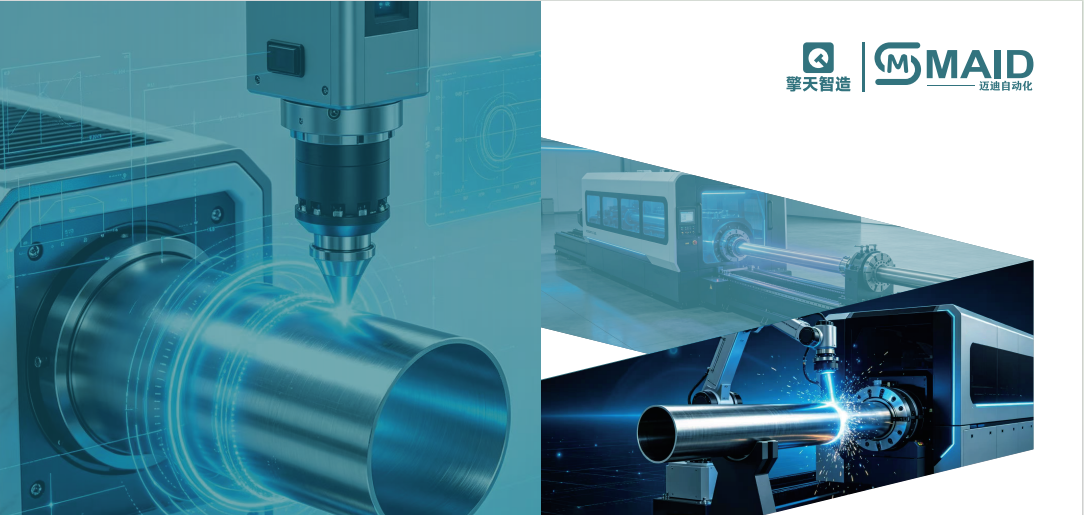
What does a 50mm tail end length mean?Why does it directly determine material utilization rate?
The real cost of tail end waste from a 6-meter pipe.
Tail end length refers to the remaining section of each pipe that cannot be utilized after cutting, held by the chuck. During laser pipe cutting, the chuck must clamp the pipe end to complete the final cut; this clamped area cannot be cut and is discarded as waste after processing.
Take a standard 6-meter pipe as an example: if the machine's tail end length is 500mm, 8.3% of each pipe becomes scrap directly;when the tail end length is reduced to 50mm, this ratio drops to 0.83%. The difference is not 'a little,' but an extra 450mm of usable material per pipe.
Converting to mass production numbers makes it more intuitive—assuming 200 pieces of 6-meter pipe are processed per day:
- 500mm tail: 100 meters of pipe wasted per day, which is 3,000 meters over 30 days.
- 50mm tail: 10 meters wasted per day, 300 meters per month.
For enterprises consuming thousands of tons of pipe per month, this difference directly shows up in the raw material procurement bill. More critically, the tail length is determined by the equipment structure, not something an operator can change by 'paying more attention'—it depends on the chuck design, the relative position of the feed mechanism and the cutting head. So when selecting equipment, looking at the tail length is essentially choosing a fixed material waste rate.
Calculation formula for tail length and material utilization rate
The calculation of material utilization rate is not complicated:
Material utilization rate = actual total length of finished products ÷ total length of input pipes × 100%
Take a single 6-meter pipe and cutting it into several finished pieces as an example:
- When the tail scrap is 50mm: usable material is 5950mm, utilization rate = 5950 ÷ 6000 = 99.2%
- When the tail scrap is 500mm: usable material is 5500mm, utilization rate = 5500 ÷ 6000 = 91.7%
The difference between the two is 7.5 percentage points. Note that this does not yet account for the cutting kerf width and the cutting loss between workpieces; the actual utilization rate will be slightly lower than the above values, but the proportional difference caused by the tail scrap length remains unchanged.
It should be noted that the tail scrap length is not one of the key variables to consider when measuring utilization rate. Whether the length combination of finished workpieces can "coincidentally" divide the remaining pipe length evenly will also affect the actual utilization rate. However, the tail stock length is one of the key choices, a fixed loss determined by the equipment hardware—no matter how optimized the discharge plan is, the distance that the chuck must clamp cannot be avoided.
The tail stock length of the Maidi 6012QL-3000W is 50mm, which is at a relatively good level among current laser tube cutting machines. If your processing scenario is mainly large-batch, long-cycle continuous production, this parameter is worth focusing on as a key comparison item during selection.
Why is the tail stock long in traditional cutting?Comparing the technical advantages of laser tube cutting machines
Limitations of tail stock control in traditional sawing and semi-automatic equipment
Traditional sawing equipment usually uses single-side clamping, and a length of the tube must be reserved before the cutting point for the fixture to bite. As the tube gradually becomes shorter, the remaining part becomes increasingly difficult to clamp stably, and it is prone to vibration and deflection during cutting, leading to a decline in cut quality. To avoid scrapping, operators often stop using the pipe while a relatively long section remains, discarding it as tail waste.
Although semi-automatic equipment has improved this, the clamping position during manual feeding is difficult to precisely unify each time, and to ensure the final section can be cut, a longer allowance still needs to be reserved. This is the fundamental reason why tail waste is generally long in traditional equipment.
How laser pipe cutting machines shorten tail waste through chucks and the feeding system
Laser pipe cutting machines achieve this throughdual-chuck alternating feedingandprecise positioningSolve this problem. Taking the Maidi 6012QL-3000W as an example, its front chuck is responsible for stable fixation during cutting, while the rear chuck is responsible for feeding the material forward. When the tail of the pipe approaches the front chuck, the rear chuck continues to clamp the remaining pipe and push it forward, allowing the final section to enter the cutting area for processing.
The maximum spindle speed of the 6012QL-3000W chuck reaches 200r/min, and the maximum Y-axis speed reaches 150m/min. Combined with the servo motor-driven feeding system, the clamping position can be precisely controlled, eliminating the need to reserve a "safety margin" as in manual operation. This is the technical foundation that allows it to compress the remnant length to 50mm , whereas traditional sawing equipment typically leaves remnants of 200-300mm.
Reducing remnant from 500mm to 50mm, how much material cost can be saved in a year?
Take a company producing 100 tons of pipes per month as an example for cost calculation.
Taking a company with a monthly output of 100 tons of pipes as an example, assuming the average purchase price of pipes is estimated at 6000 yuan/ton (actual prices vary with material and wall thickness, here only for magnitude reference). Shortening the remnant from 500mm to 50mm means each pipe wastes 450mm less.
For a standard 6-meter pipe, 450mm accounts for 7.5% of the entire pipe. That is to say, originally, for every 100 tons of pipes cut, about 7.5 tons became scrap and waste;After shortening the tail ends, this material can be converted into finished products. Calculated at 6,000 yuan per ton, this saves about 45,000 yuan in material costs per month, and about 540,000 yuan per year.
If individual pipes are shorter, such as 3-meter pipes, the proportion of 450mm increases to 15%, and the annual savings amount to about 1.08 million yuan;Conversely, if 9-meter or 12-meter long pipes are used, the savings ratio drops to 5% and 3.75% respectively, with annual savings of about 360,000 and 270,000 yuan.
Under which working conditions is the tail-end savings effect most obvious?
The value of shortening tail ends depends on three conditions:
- The shorter the individual pipe, the more obvious the savings.: The saving ratio for 3-meter pipes is twice that of 6-meter pipes.When the production line uses a large number of short pipes, the material benefits from reduced end scraps become more prominent.
- The higher the unit price of the pipe, the greater the savings amount: For high-priced pipes such as stainless steel and aluminum alloy, the same reduction ratio in end scraps corresponds to a larger amount of savings.Calculated at 15,000 yuan per ton for stainless steel, the annual savings are approximately 1.35 million yuan.
- The larger the batch size, the stronger the cumulative effect: A monthly output of 100 tons corresponds to annual savings of approximately 540,000 yuan, while 300 tons per month corresponds to about 1.62 million yuan.
It should be noted that the above only calculates the material cost itself, excluding labor, handling, and scrap recycling discounts for end scrap disposal, so the actual savings may be higher. However, if orders are mainly small-batch and multi-variety, frequent material changes will dilute the benefits of shortened tailings. In this case, what deserves more attention is the speed of equipment changeover, rather than simply the tailings length.
Which enterprises are suitable for using short-tailings pipe cutting machines?Before selecting a model, first look at these 3 judgment criteria.
A short-tailings pipe cutting machine is not a device that "saves money just by buying it." Its value is built on two premises: your tailings are indeed wasting money, and your production volume can support the investment in this equipment. To determine whether you are suitable, you don't need to look at complex parameter tables. First answer the following three questions.
Judgment criterion 1: Whether the pipe usage reaches the threshold of scale.
This is the most critical dividing line. The value of a short-tailings pipe cutting machine lies in reducing tailings from the common 200-300mm to 50mm. The material saved per pipe is fixed, but the total amount saved depends on how many pipes you cut per day.
A rough reference: if your daily pipe usage is within a few hundred pieces, or your cutting tasks are mainly prototyping and small batches, the savings from reducing remnants are unlikely to cover the equipment investment. In such scenarios, a regular pipe cutting machine, or even a band saw, is sufficient to meet your needs.
Conversely, if your pipe cutting machine runs almost non-stop in your workshop, processing thousands of pipes daily, reducing remnants from 200mm to 50mm means each pipe yields an extra 150mm of usable material—calculate this against the pipe unit price and daily output, and the figure becomes very substantial. Industries such as automotive parts and metal furniture, which have large batch sizes and relatively fixed pipe diameter specifications, typically find it easier to cross this threshold.
Criterion 2: Whether existing remnants have already impacted order profitability
The second criterion is more direct: review your production reports from the past few months and calculate the proportion of remnants to the total weight of purchased pipes. If this proportion has been consistently below 3%, it indicates that your nesting and cutting management is already quite refined, and the potential for improvement from replacing equipment is limited.
However, if the remnant proportion is significantly high, or if you often find yourself forced to repurchase whole pipes because the pipes are 'not long enough,' it indicates that remnants have already substantially eroded order profitability. At this point, the short-tail pipe cutting machine solves not a 'nice-to-have' problem, but directly reduces the unit material cost.
Also, note a point that is easy to overlook: tailings are not just material costs; they also involve labor costs for handling, storage, and secondary processing. The shorter the tailings, the lower the frequency of manual handling and sorting required. If your production line has dedicated personnel for clearing tailings, this labor savings should also be counted into the benefits.
In which cases is it not recommended to buy?
In the following three situations, it is advised not to consider this equipment for now:
- Frequent changes in pipe specifications: If your orders switch between multiple pipe diameters and wall thicknesses daily, the advantage of fully automatic feeding will be offset by frequent machine adjustments, and the equipment utilization rate will not increase.
- The site power conditions have not been confirmed.This equipment has a total power of 24KW and requires a 380V power supply.If the existing power capacity in the workshop is insufficient, the cost of transformer or power system upgrades may exceed budget expectations.
- Order volume fluctuates significantly.The production rhythm of full load during peak seasons and shutdown during off-seasons will spread equipment depreciation costs over fewer outputs, significantly extending the payback period.
How should the budget be allocated?
If you determine that your scenario is indeed a match, it is recommended to allocate the budget in this priority order: equipment procurement cost can take up the majority, but do not overlook installation and commissioning fees, power adaptation costs (such as transformers or frequency converters), and operator training expenses. Many companies only focus on the equipment quote and ignore the latter three items, only to discover after installation that the total investment exceeds expectations.
In addition, if your production line has plans for automation upgrades in the future, prioritize confirming whether this equipment can interface with subsequent sorting and stacking equipment, rather than only looking at current cutting capabilities.
Frequently Asked Questions
Q: What is the actual difference between fully automatic loading and semi-automatic loading? The core value of fully automatic loading is reducing manual intervention, suitable for continuous production scenarios. If your production line already has personnel responsible for loading and unloading, semi-automatic may be sufficient;But if the goal is to reduce labor and achieve unattended operation, fully automatic is a necessary configuration.
Q: Can the 50mm tail end be achieved for all pipe diameters? The tail end length is related to the equipment's clamping method for the pipe, and the actual tail end length may vary with different pipe diameters and wall thicknesses. It is recommended to conduct an actual cutting test with the pipe specifications you commonly use to confirm.
Q: Can this equipment be integrated into an existing pipe production line? The equipment supports automated production line integration, but the specific integration method depends on the layout and control system of your existing production line. You need to provide your production line details to the Maidi team to confirm the interface matching solution.
Q: Will the 3000W laser power cause over-cutting on thin-walled pipes? The advantage of 3000W power lies in cutting thick-walled pipes and increasing speed; for thin-walled pipes, the heat-affected zone can be controlled by adjusting cutting parameters. For specific results, it is recommended to conduct sample cutting verification with your typical pipe materials.
Learn More
The tail material length is a fixed loss determined by the equipment structure. When selecting a model, comparing one more parameter can potentially save hundreds of thousands of yuan in material costs each year after production.If you are evaluating an upgrade plan for a pipe cutting machine, you can submit the common pipe specifications, monthly output, and current tail material ratio to the Maidi team. We will combine your actual working conditions to help confirm whether the 6012QL-3000W is suitable for your production line, and provide sample cutting verification support.
Related products:6012QL-3000W Fully Automatic Loading Laser Pipe Cutting Machine