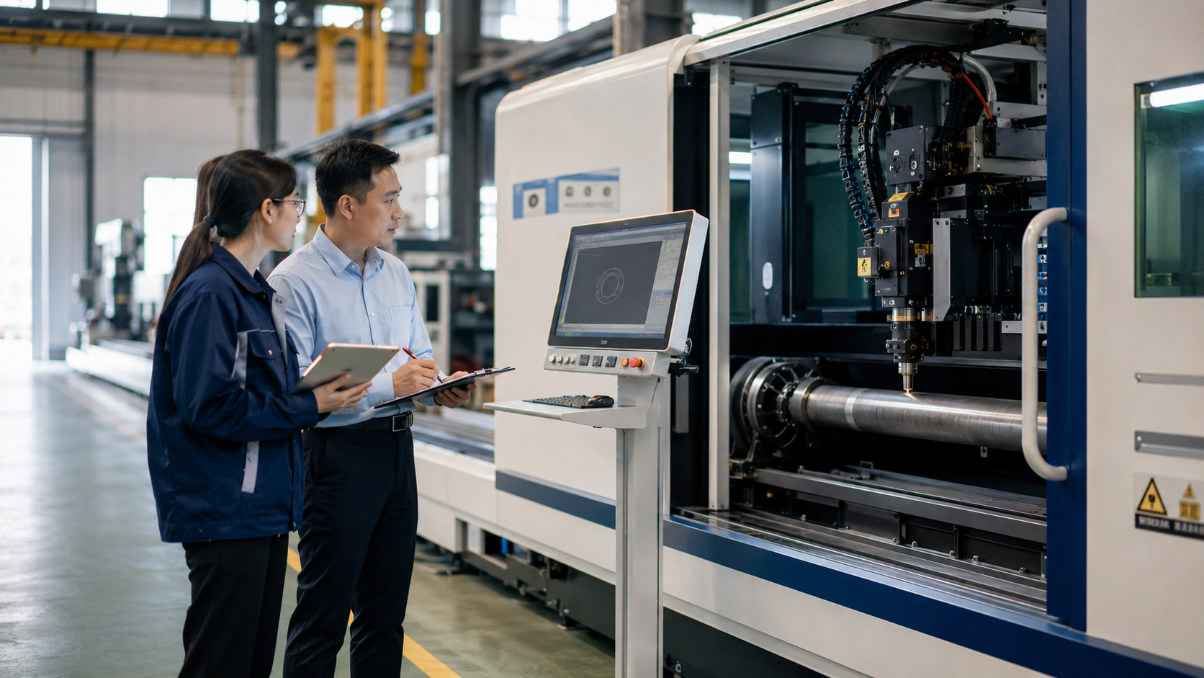
What is the front chuck offset function, and how does it prevent operational collisions?
The front chuck offset function is a standard safety feature of the MaiDi 6012MYS upgraded laser tube cutting machine. Its core value lies in solving the potential physical collision problem between the front chuck and the laser cutting head during short tail material cutting, thereby ensuring the safety of equipment operation and personnel.
How the front chuck moves to avoid the laser cutting head
Simply put, this function avoids collisions through intelligent system control of the chuck's movement path. When cutting long tube materials, the front chuck clamps the front end of the tube, positioned far from the cutting head, posing no risk. However, when cutting an ultra-short tail material of only 50mm, the front chuck must move to a position very close to the laser cutting head for clamping, which creates a collision hazard.
The working principle of the front chuck offset function is: the system pre-sets a safe retraction path for the front chuck. When the cutting program approaches the tail material, the front chuck does not simply move horizontally to the target position; instead, it first executes adescend or move laterallyan 'offside' maneuver, actively avoiding the space occupied by the laser cutting head, moving to a safe position, and then advancing to the clamping point. The entire process is automatically completed by the equipment control system, requiring no manual intervention from the operator, ensuring that the chuck and the cutting head always maintain a safe distance during high-frequency ultra-short tail processing.
Core Safety Difference from Traditional Fixed Chucks
Traditional fixed chucks or some simple chuck systems lack this intelligent avoidance logic. If cutting short tails, the operator might need to manually adjust the chuck position or risk letting the chuck approach the cutting head, which greatly increases the probability of equipment collision due to operational error. A single collision could damage the valuable laser cutting head or chuck mechanism, causing production interruption.
In contrast, the standard front chuck offside function builds safety into the equipment's basic functionality. It transforms the high-risk step of 'collision prevention' from relying on manual experience to a deterministic outcome guaranteed by systematic automation. This not only directly protects the equipment but also reduces material waste caused by setting excessively long tail lengths due to collision concerns (standard tail length can be reduced to 50mm), allowing operators to perform continuous production with greater peace of mind.
Next Steps for ConfirmationIf you plan to perform extensive short-tail cutting to save material, or if your production environment has strict requirements for operational safety, this feature is a key consideration. You can further confirm whether the system's avoidance action will interfere with your existing loading and unloading process under your specific pipe specifications and cutting rhythm.
How does the front chuck overtravel function directly improve cutting efficiency and reduce tail length?
The front chuck overtravel function directly improves production efficiency by optimizing the process at the end of the cut, and works in synergy with the 'tail length only 50mm' goal to reduce material waste.
Operational Procedure for Reducing Clamping Adjustment Time
When cutting the end of a long pipe, traditional equipment often requires the operator to pause the machine, manually adjust the pipe's position, or perform a secondary clamping to finish cutting the last segment. The standard front chuck over-travel function of the MaiDi laser pipe cutting machine has changed this process. It allows the front chuck, under the control of the cutting program, to actively move beyond its conventional limit position and smoothly feed the pipe forward.
This way, the cutting head can complete the processing of the last segment in one continuous operation, without needing to stop and adjust midway. This process reduces operational interruptions and manual intervention,thereby shortening the cutting cycle for a single pipe and directly improving the overall operational efficiency of the equipment.
The collaborative mechanism for achieving a 50mm ultra-short tail.
The achievement of an ultra-short tail is the result of the coordinated work of multiple components of the equipment. The front chuck overtravel function provides the key mechanical prerequisite for this: it ensures that when the pipe is about to run out, the equipment still has sufficient travel and precision for control. At this time, the front and rear pneumatic chucks work closely with the four-axis linkage system to precisely calculate and execute the cutting path, thereby controlling the end of the pipe that can no longer be clamped (i.e., the tail material) to an extremely short length of about 50mm.
The front chuck overtravel function is the foundation for this collaborative mechanism to be realized.It makes it possible to reduce tail material waste to an extremely low level, directly improving the material utilization rate of each pipe.
What is the practical value of this function in the metal furniture pipe cutting scenario?
Metal furniture pipe cutting often involves characteristics such as a wide variety of pipe specifications, varying batch sizes, and relatively short cutting lengths. The standard front chuck overtravel function provides direct support for safety, efficiency, and material utilization in this scenario.
Safety and convenience for cutting short materials and multiple varieties.
When processing short pipe fittings, traditional equipment may rely solely on single-point clamping by the rear chuck, which can easily cause shaking due to the overhanging part, affecting precision and posing safety hazards. The front chuck overtravel function allows the front chuck to retract and make way, enablingsimultaneous clamping of the pipe by both the front and rear chucks.For short materials, this dual-clamping mode provides stable support, reducing the risk of vibration during the cutting process, making operation safer and cutting more precise.
How to cope with the production rhythm of frequent changeovers
In furniture production, pipe dimensions often need to be switched frequently. Thanks tothe front and rear pneumatic chucksCombined with the offset function, the clamping and adjustment process of the equipment becomes more convenient and quick when changing pipes of different diameters or lengths. This reduces the downtime waiting caused by changeover, helping the production line adapt more flexibly to small-batch, multi-batch demands.
In addition, this function supportsultra-short tail cutting (the tail can be controlled to about 50mm), which helps improve material utilization and aligns with the production goals of cost reduction and efficiency enhancement.
Which production situations are more suitable for this function as standard?How to evaluate its adaptability?
To evaluate whether the front clamp offset function is needed, the core is to see if the pain points it can solve are closely related to your production scenario. This function allows the cutting head to cut past the front chuck, with the direct value being a significant reduction in the uncuttable portion at the front end of the tube (i.e., the "ultra-short tail material") and increased flexibility in processing short materials.
Recommended Priority Scenarios
This function should be a priority consideration when your production meets any of the following conditions:
- Material Cost Sensitivity: The unit price of the processed tubing is high (e.g., stainless steel, copper, special alloys), and the tail material generated from each cut directly constitutes a cost waste.The front chuck over-travel can control the effective tail material to within 50mm, significantly improving material utilization.
- High Production Volume, Fast Cycle Time: In continuous batch cutting, reducing non-productive loading time and tail material handling time can effectively improve Overall Equipment Effectiveness (OEE).The function supports faster pipe positioning and cutting cycles.
- Frequent processing of workpieces shorter than the material length: When multiple short pieces need to be continuously cut from a long pipe, traditional equipment may require multiple movements or waste a large amount of front-end material.The front chuck overtravel allows the cutting head to start working from the very front end of the pipe, enabling flexible material feeding.
- Pursuing high precision and consistency: When performing complex processing such as pipe intersection lines or end-face bevel cuts, front chuck overtravel ensures stable support and precise cutting when starting from the pipe end, avoiding vibration or deviation caused by lack of clamping at the material's front end.
Key parameters to confirm during evaluation
Before deciding, please check your own situation against the following points:
- Your primary cutting material and unit price: Evaluate whether the cost savings from tail material reduction are significant.If you are cutting inexpensive carbon steel and the production batch is very small, the benefits may be limited.
- Typical production tasks: Analyze the length distribution of the workpieces you cut daily.If the vast majority involve using the entire tube (e.g., cutting lengths close to 6 meters), then the frequency and benefit of using the front carriage overtravel will be reduced.Conversely, if you frequently need to cut multiple short pieces of different lengths from the same tube, its value becomes prominent.
- Existing production bottlenecksIs the current efficiency loss mainly due to material waste, or downtime for loading and changing materials?The front clamp overshoot primarily addresses the former and indirectly optimizes the latter.
- Precision RequirementsFor production requiring extremely high precision for the first piece cut, the stable starting environment provided by the front clamp overshoot is a beneficial guarantee.
Judgment Regarding 'Cutting Long Materials as the Main Task'Even if cutting long materials is the main task, specific analysis is still needed. If the remaining 'front-end scrap' after cutting long materials is still long, waste exists;If a long material head must be reserved due to process limitations, the front clamp overshoot directly creates value. It is recommended to compile the actual cutting data from the past period.
Decision Reference
If your scenario primarily matches the "recommended priority" situation, and the evaluation parameters indicate clear potential for reducing tailings loss or improving efficiency, then equipping with the standard front chuck overtravel function is an effective investment to enhance your production economy and flexibility. You can provide the specific pipe specifications (diameter, length, unit price) and cutting requirements from your current production tasks to our technical team. They can help you simulate and calculate the specific payback period brought by this function.
Frequently Asked Questions
Q: If my factory frequently cuts short pieces of different lengths, but the pipe diameter also varies greatly (ranging from 30mm to 100mm), can this function still be used? Answer: Yes. The value of the front chuck overtravel function lies in its structural design, which allows the cutting head to operate at a more forward position, regardless of the pipe diameter.
As long as your pipe diameter is within the 15-120mm range supported by this equipment, this function can effectively reduce front-end scrap, helping you flexibly meet the short-piece cutting needs for multiple varieties and small batches.
Question: Is this function only for cutting scrap, or is it helpful for all cutting processes? Answer: It primarily acts during theinitial stageof the cutting process. For complex shapes that require precise starting cuts from the pipe end (such as intersecting lines), or when continuously cutting multiple short pieces from a single pipe, it provides crucial stable support and precise positioning capabilities. This indirectly improves overall cutting quality and efficiency, rather than just reducing final scrap.
Question: What is the biggest misconception to avoid during evaluation? Answer: Avoid dismissing it based solely on the 'feeling that scrap waste isn't significant.' You should quantify and track: What is the total length and weight of pipe material you discard each month due to inability to cut from the front end?
What is the net cost of this material? Comparing this figure with the incremental cost of the equipment upgrade provides a more objective basis for decision-making.
Learn More
If you are unsure about the objectives, users, existing materials, or subsequent maintenance methods, it is recommended to confirm this information first before determining whether the 6012MYS Upgraded Square-Round Integrated Laser Tube Cutting Machine is suitable.
Related Products:6012MYS Upgraded Square-Round Integrated Laser Tube Cutting Machine