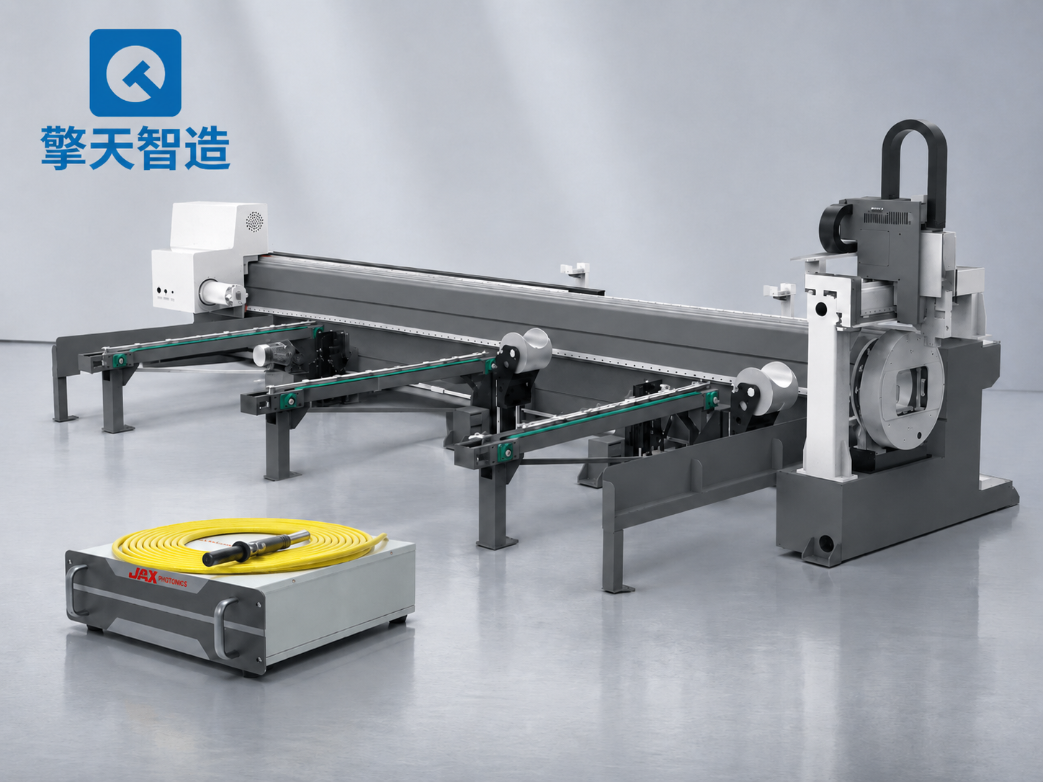
What processing can a mini economical fiber laser tube cutting machine with standard configuration cover on its own?
The core positioning of this equipment is very clear:Two-dimensional cutting, hole opening, and truncation of small-diameter round tubes and square tubes. If the tubes you have are within this range, the standard configuration usually allows you to start work directly without additional customization.
1500 watts, 0-10mm, 4-axis: what do these three parameters determine respectively?
1500 wattsdetermines "whether it can cut through and how fast it can cut." It corresponds to the daily processing needs of thin-walled to medium-thick-walled tubes, paired with a cutting speed of 7000-8000mm/min, suitable for batch blanking rather than occasionally cutting one or two pieces. The higher the power, the greater the upper limit of cuttable thickness, but at the same time the higher the requirements for on-site power supply, cooling, and maintenance—this is the starting point for determining later whether custom power is needed.
0-10mmis the applicable range of cutting thickness, and it is also the figure on this machine that you most need to verify against your own orders. It means that the standard configuration covers thin-wall and medium-thick-wall pipes;if you handle thick-wall pipes above 10mm year-round, the standard configuration is not enough, and you need to move to higher power.
4-axisdetermines the degrees of freedom of the cutting motion. The 4-axis corresponds to two-dimensional processing of pipes—rotation and feed work together to complete cutting and hole opening, rather than complex intersecting-line cutting in three-dimensional space. This directly defines its capability boundaries: **holes, slots, and cut-offs within a plane are no problem, but complex spatial curved surface cuts are outside the scope of the standard configuration.
**
What it does is two-dimensional cutting, hole opening, and cut-off of small-diameter round pipes and square tubes.
Looking at these three parameters together, the processing that the standard configuration can cover becomes very clear:
- Fixed-length cut-off of round pipes and square tubes: Work such as cutting guardrail posts to length, which requires consistent length and flat cuts, is its basic territory.
- Hole opening in pipe walls: For metal furniture and advertising frames that need mounting holes or cable routing holes opened on the pipe surface, two-dimensional hole opening can accomplish this.
- Simple contour cutting: pipe end cuts, irregular grooves within a plane, etc.
The corresponding typical scenarios are: cutting stainless steel round pipes and square pipes, cutting guardrail posts to length, processing metal furniture tubing, and making advertising frames — the common point isthe pipe diameter is not large, two-dimensional processing is the main focus, and there are many order specifications but limited quantities per batch。
Conversely, the following situations cannot be handled by a standard configuration itself, and no amount of parameter adjustment will solve them: the pipe diameter exceeds the "small diameter" range, the wall thickness consistently exceeds 10mm, or three-dimensional intersecting lines or complex spatial cuts are required. These are the real trigger conditions for the later discussion of "whether customization is needed."
The recommended order of judgment is: first measure the thickest and heaviest pipe you have on hand, then check whether the cuts are all within a two-dimensional plane. If both items fall within range, the standard configuration is sufficient;if one item is out of bounds, then look further into customization options.
Under what circumstances is the standard configuration sufficient and no customization is needed?
If your orders are concentrated inTwo-dimensional cutting, hole opening, and truncation of small-diameter round tubes and square tubes, and the following two conditions are met, the 1500 W standard configuration is sufficient and no additional customization is needed.
The pipe material and thickness in the orders fall within 0-10mm, and are mainly steel, aluminum, stainless steel, and iron.
The 1500 W with 0-10mm cutting thickness corresponds exactly to common orders such as guardrail post cutting, metal furniture tubing, and advertising frames. These jobs involve small pipe diameters and standard wall thicknesses, requiring flat cuts and consistent lengths, rather than chewing through thick walls or large-diameter pipes. As long as orders do not consistently exceed this thickness range over the long term, customizing for higher power means spending money on capacity you will not use.
The production pace matches 7000-8000mm/min, and flexible changeover is more important than extreme power.
The real pain point in these scenarios ismany specifications and small batch sizes: today you cut square tubes, tomorrow you switch to round tubes, and the day after you change the hole positions. A cutting speed of 7000-8000mm/min combined with a 4-axis configuration is enough to handle this pace. Rather than pursuing higher power for that little bit of extra maximum speed, it is better to focus on whether changeovers are smooth—this is the key to determining how many orders you can take in a day.
If you meet the above conditions, the standard configuration is the more worry-free choice. For the specific matching situation, it is recommended to send the commonly cut materials, wall thickness, pipe diameter, and average daily output to the team for confirmation.
What signals indicate that the standard configuration may not be enough and that power or configuration customization needs to be considered?
The boundaries of a conventional configuration are clear: 4-axis, 1500 W, 0–10 mm cutting thickness, corresponding to two-dimensional cutting, hole opening, and severing of small-diameter round tubes and square tubes. The more the following signals appear, the more worthwhile it is to seriously evaluate power and configuration customization, rather than being pushed along by the idea that "the higher the power, the better."
Tube thickness, material, or diameter continuously exceeds the boundaries of the conventional configuration.
- The wall thickness is close to or exceeds 10 mm for a long time, and it is a regular order rather than just one or two pieces occasionally;
- The material is mainly thick-walled stainless steel or carbon steel, rather than thin-walled tube;
- The diameter clearly exceeds the small-diameter range, or square tubes and special-shaped tubes account for a high proportion.
In these cases, the power margin of 1500 W will be continuously maxed out, and the cutting speed and cross-section quality may fluctuate. The significance of customizing higher power is to keep commonly used thicknesses within the equipment's comfort zone, rather than its limit zone.
The processing range, cycle time, or automation requirements do not match the 4-axis, 2D cutting capability.
What 4-axis equipment can do is 2D cutting, hole opening, and cutting off of pipes. If the actual requirements include pipe end beveling, intersecting line cutting, 3D miter cutting, automatic loading and unloading, or integration with the production line, the standard configuration will not match—this falls under differences in the number of axes, structure, and automation level, and cannot be solved by adjusting parameters. When a single batch requires a high cycle time and manual loading and unloading becomes a bottleneck, this should also be included in the evaluation.
It should be noted that customization means improved adaptability, while also bringing a tradeoff in cost, delivery time, and subsequent maintenance complexity. Whether it is worth it depends on your order distribution, not on a single parameter. It is recommended to organize the wall thickness range, material, diameter, and cycle time requirements of orders from the past three months, and then confirm with QingTian whether the standard configuration plus optional add-ons can cover them, or whether customization at the power or structural level is truly needed.
Before deciding on customization, what scope, price increase, and delivery time issues should be confirmed with QingTian?
Customization is not as simple as "tweaking" a standard machine. For individual hardware processing businesses and small pipe factories, customization means that budget, delivery time, and subsequent maintenance will all change accordingly. Before paying a deposit, asking the following questions clearly is far more worthwhile than arguing afterward.
Customizable scope: to what extent can power, configuration, and processing range each be modified?
The standard model is 1500 W, 4-axis, cutting thickness 0–10 mm, aimed at two-dimensional cutting, hole opening, and cutting off of small-diameter round pipes and square pipes. If your work basically falls within this range, customization is usually unnecessary; going directly with the standard configuration actually gives the shortest delivery time and the lowest risk.
The situations that generally require discussing customization are three types:
- Power: The wall thickness or material of existing pipes exceeds the stable processing range of standard machines, or you will take on thicker materials in the next six months.
- Configuration: For example, whether the clamping method, loading method, control system, or laser head brand can be replaced, which directly affects operating habits and subsequent spare parts procurement.
- Processing range: Whether the pipe diameter, pipe length, and cutting length cover the specifications you frequently handle, especially orders with fixed lengths such as guardrail posts and advertising frames.
What you should ask is not "can it be modified," but:which item to modify, which original performance will be affected after the modification, and which accessories will no longer be universal. These three points determine whether customization helps you make money or brings you trouble.
Price increase and lead time: the actual impact of customization on budget and delivery schedule
Customization price increases usually come from three parts: hardware replacement, software/control system adaptation, and the labor hours for single-unit non-standard production. Lead time depends on whether the changes involve redesign, material preparation, and debugging.
It is recommended to directly confirm these specific questions with QingTian:
- For the item I want to change, is it an optional configuration based on the standard machine, or does it require redesign?
- Is the price increase quoted per item or as a package price, and does it include installation, debugging, and operation training?
- How much longer is the lead time for a customized machine than for a standard machine, and does this time include debugging and acceptance?
- If there is a problem with the customized part, are the warranty scope and response method the same as for the standard machine?
How to make the final choice
If the power and processing range of the standard machine can cover more than 80% of your orders, choose the standard machine and save the money for consumables and working capital. Only when the "jobs you cannot take" have clearly affected your income, and you can calculate how long it will take for the custom price increase to pay for itself, is it worth paying more and waiting longer for customization. If you cannot calculate this account clearly, do not decide yet.
Frequently Asked Questions
Q: I only occasionally cut thicker tubes. Do I need customized power? First confirm the stable cutting performance of the standard machine under your actual material and wall thickness, then determine whether it is "occasionally unable to cut" or "often unable to cut." Occasional jobs can be outsourced, and only frequent jobs are worth paying more for power.
Q: After custom configuration, are accessories still easy to buy? This is exactly the key point to confirm with QingTian: what are the brands and models of the replaced laser head, control system, etc., and what are the subsequent accessory supply and replacement cycles? Don't just look at the current quotation.
Q: Will a custom machine have a long delivery delay? It depends on the extent of the changes. Optional changes are usually quick, while changes involving redesign will significantly lengthen it.
Before signing, write the delivery time into the contract and clearly define the responsibility for delays.
Q: Is the added cost of customization worth it? Use a simple standard to judge: after customization, how long will it take for the newly added orders to cover the extra cost? If the payback period exceeds your expected lifespan for this equipment, it is not worth it.
Learn more
If you are still judging whether the standard configuration can cover your existing orders, you can organize the commonly cut materials, wall thickness range, pipe diameter specifications, and average daily output, and send them to the Qingtian Zhizao team.Based on your actual working conditions, we will help you confirm whether the standard configuration can start production directly, or whether further evaluation of power or configuration customization is needed.