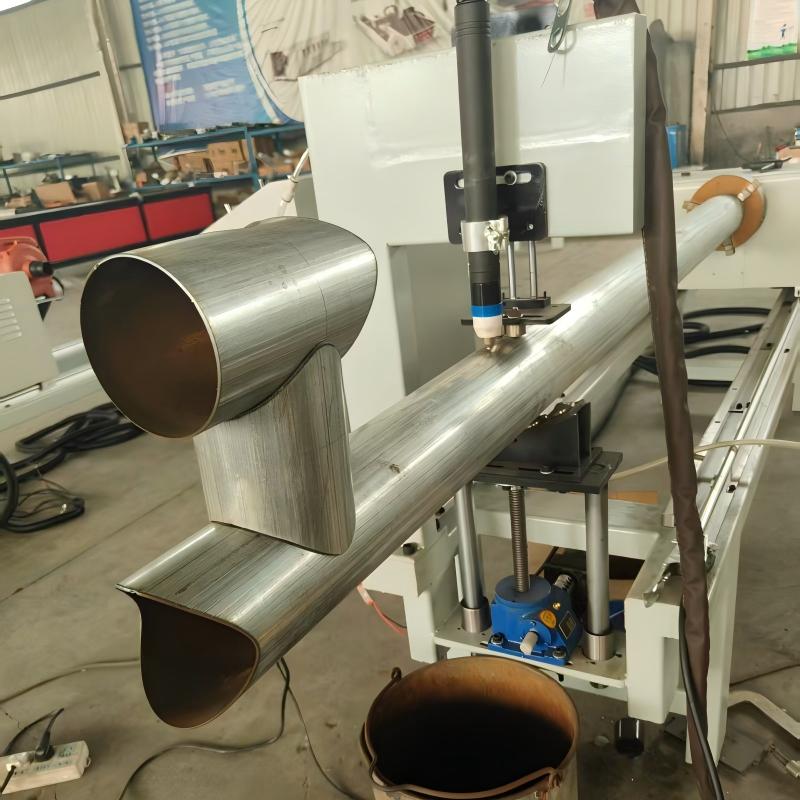
What exactly is being compared between outsourcing and self-purchasing: first look at the differences in processing methods between the two paths.
Outsourcing and self-purchasing appear on the surface to be the difference between "spending a processing fee" and "spending money on equipment," but what is actually being compared is three things:who does the cutting, who manages it, and who is responsible when problems arise. Once the operating methods of these two paths are laid out clearly, the later comparisons of cost, pace, and risk will have a common language.
Outsourced processing: send the pipe out, and settle by piece or by meter.
The way outsourcing works is: you prepare the pipe, send it to the processor, and they cut it according to your drawings or size requirements; after completion, the processing fee is settled by piece, by meter, or by batch.
Under this path, the cutting task'sexecuting party is the outsourcing provider. The equipment, operators, cutting process parameters, and daily maintenance are all in the other party's workshop; you do not need to invest money or effort in these.
But responsibility has not been entirely transferred away. What you still need to manage is:
- Incoming materials: Whether the pipe specifications, material, and batch are consistent. If the wrong material is sent, causing incorrect cutting, the responsibility is usually yours.
- Drawing and dimension confirmation: What length to cut, what holes to make, and what tolerance requirements are needed must be clearly provided by you.
- Delivery schedule coordination: You can only communicate about how tight the other party's production schedule is and when your order can be scheduled; you cannot decide it.
- Acceptance inspection: Whether the cut parts meet the requirements must be checked by you yourself.
In other words, the subcontractor has outsourced the "cutting action," but the final responsibility for whether the result meets expectations remains on your side.
Buying a mini economical fiber laser tube cutting machine yourself: putting cutting capability into your own workshop
After purchasing the equipment yourself, you become the entity executing the cutting. Take this QingTian mini economical fiber laser tube cutting machine as an example. It is used for 2D cutting, hole drilling, and cutoff processing of small-diameter round tubes and square tubes. It is equipped with 4 axes, a 1500 W fiber laser, and a liquid cooling system, supports continuous wave operation mode, and can operate continuously for long periods.
This means that several responsibilities that originally belonged to the subcontractor have shifted back to your own workshop:
- Production scheduling pace: When to cut and how much to cut is determined by your own orders, and you no longer have to wait for the outsourcing party's schedule.
- Process and parameters: What material to cut, how thick it is, and at what speed all need to be set and adjusted by you yourself.The equipment supports multiple graphic formats, but the segment from drawing to finished product is your responsibility.
- Quality responsibility: For cut quality, dimensional consistency, and hole positions, when problems occur there is no longer an outsourcing party to fall back on, and you need to troubleshoot on your own whether the issue is the equipment, the parameters, or the incoming material.
- Daily maintenance: The maintenance and replacement of components such as the liquid cooling system, laser head, and lenses fall on you.The product materials mention adjustment-free and maintenance-free operation and low accessory costs, but the specific maintenance frequency and consumable replacement cycle need to be confirmed based on your actual usage intensity.
- Personnel: Who operates, who programs, and who inspects need to be arranged by you, or you do it yourself.
The responsibility attribution of the two paths, clear at a glance in one table
| Item | Outsourced processing | Self-purchased equipment |
| Who does the cutting | Operated by the outsourcing party | You or your workers |
| Production scheduling pace | Affected by the other party's scheduling | Decided by yourself |
| Process parameters | The outsourcing party is responsible | Set and debug by yourself |
| Incoming material responsibility | You are responsible | You are responsible |
| Cutting quality responsibility | The outsourcing party bears execution responsibility, and you bear acceptance responsibility | All borne by you |
| Equipment maintenance | Borne by the outsourcing party | Borne by you |
| Funding investment method | Processing fee paid per piece/per meter/per batch | One-time equipment investment plus routine operation and maintenance |
The key to this table is not "which is better," but rather:Self-purchase takes back both the execution authority and responsibility for cutting. You gain scheduling freedom and process control, while also having to take on debugging, maintenance, and quality troubleshooting—things you originally did not have to worry about.
So the starting point for judgment is not the equipment price, but rather: whether you have a stable cutting volume, whether someone can manage this equipment, and whether you are willing to take over quality responsibility from the outsourcing party. If any of these three points is unclear, it is worth first confirming with the QingTian team how well the equipment matches your specific pipe specifications and output before deciding whether to take the self-purchase route.
Which pipes and thicknesses can be handled by both paths, and which are only more flexible with self-purchase
Two-dimensional cutting, hole making, and truncation of small-diameter round pipes and square pipes
The overlap between outsourcing and self-purchase is concentrated in the two-dimensional cutting, hole making, and truncation of small-diameter round pipes and square pipes. For orders such as guardrail post cutting, metal furniture pipes, and advertising frames, which have many specifications, small batches, and frequent changeovers, outsourcing can take them on, and self-purchase can also cover them; the difference lies in who has the flexibility.
Judgment of order coverage with 1500 watts and 0-10mm thickness
This mini economical fiber laser pipe cutting machine has a 1500-watt, 4-axis configuration, with a nominal cutting thickness of 0-10mm, suitable for steel, aluminum, stainless steel, and iron. For cutting stainless steel round pipes and square pipes within 10mm, both paths can do it;Above 10mm, the equipment's conventional capability does not cover it, so it can only rely on outsourcing, or switch to a higher-power configuration.
To determine which side an order falls on, look at two points: whether the thickest batch of pipe fittings exceeds 10mm;whether the diameter falls within the small-diameter range. 0-10mm is the nominal range; the actual thickness that can be cut also depends on the material, wall thickness, and cutting speed requirements. Stainless steel is harder to cut than carbon steel. When an order falls in the 8-10mm range, it is recommended to tell the Qingtian team the material, wall thickness, and single-batch quantity to confirm the actual results.
Conclusion boundary: thickness within 10mm, mainly small-diameter round pipes and square pipes, frequent changeovers — buying your own is more flexible;thickness often exceeds 10mm, or the diameter clearly exceeds the small-diameter range — leave this part to outsourcing. The diameter range and maximum pipe length need to be confirmed with the product side.
Who outsourcing and self-purchasing each suit: how to choose for guardrail posts, metal furniture, and advertising frames
Order characteristics suitable for continuing to outsource
For orders such as cutting guardrail posts, where pipe diameter and wall thickness are relatively fixed and single-batch quantities are large, outsourcing has an advantage in unit price. If monthly usage is stable, materials can be prepared in advance, and delivery times are flexible, continuing to outsource is more worry-free. But outsourcing production scheduling is controlled by others, making it difficult to insert orders during peak seasons; when delivery is delayed, your own installation team has to wait for materials.
When orders are extremely unstable and the site or power supply is inadequate, self-purchasing is not a priority option either.
Scenarios suitable for self-purchasing a mini economical fiber laser tube cutting machine
Metal furniture tube processing requires hole drilling and cutting, while advertising frame production involves many specifications and many single-piece customizations, so changeover speed is efficiency. For such small orders, outsourcing often quotes high prices and schedules them late, because the setup cost cannot be spread out. The value of buying your own equipment lies in: completing punching and cutting on the same tube in one clamping, importing graphic files directly, and not needing to change molds when changing specifications, which suits a pace of cutting several different sizes a day.
The premise is that the tubing falls within the range of small-diameter round tubes and square tubes, with thickness within 0-10mm. If it exceeds the thickness or diameter range, or the site power supply is not available, buying your own is not the preferred option. When unsure, sort out the monthly processing volume, commonly cut pipe diameter and wall thickness, and the most urgent delivery date, then confirm whether the standard configuration can cover the main orders.
Operating costs, operational difficulty, and maintenance: how to calculate the long-term account of buying your own
Outsourcing is settled by piece, and the expense is visible;Buying your own requires a large upfront investment, but the marginal cost spread over each tube will decrease as production volume increases. Whether this account can break even depends on three key variables: your actual monthly cutting volume, the stability of the equipment during continuous operation, and later-stage maintenance and parts expenses.
What high electro-optical conversion efficiency and low operating costs of fiber laser mean
For sole proprietors and small factories, the most practical aspect of "low operating costs" is electricity and consumables. Fiber lasers have high electro-optical conversion efficiency, meaning they consume less electricity for the same cutting volume;combined with a liquid cooling system, they support long periods of continuous operation, so the equipment will not frequently shut down due to overheating. But note:This does not equal "zero cost."。
Protective lenses, nozzles, and gas (if auxiliary gas is used) are all ongoing expenses. The specific unit prices and replacement cycles need to be confirmed with the product supplier, because they vary greatly depending on the cutting material and thickness.
To judge whether self-purchase is cost-effective, first calculate a rough threshold: divide your total monthly outsourcing processing fee by the equipment's estimated monthly depreciation plus monthly operation and maintenance costs. If the outsourcing fee is significantly higher than the latter, and you have stable orders, self-purchase is more likely to pay for itself;if orders are scattered and specifications change frequently, the flexibility of outsourcing is actually more valuable.
The true meaning of adjustment-free and maintenance-free operation, liquid cooling system, and low accessory costs
"Adjustment-free and maintenance-free" should be understood as lowering the threshold for daily operation, not as requiring no attention at all. This machine uses a 4-axis configuration, Fangling control system, and Raytools laser head, supports multiple graphic formats, and its operation is closer to the process of "import drawing—align tool—start," so beginners can get started after training. However, the following items still require regular attention:
- Cleaning and replacement of protective lenses
- Coolant condition and level check
- Cutting head nozzle wear
- Daily cleaning and lubrication of guide rails and chucks
"Low accessory cost" is relative to the whole machine and the laser; specifically, the prices of consumable parts such as protective lenses and nozzles, as well as the lifespan and repair costs of the laser itself, are items that must be confirmed with the product supplier. These figures directly determine your holding costs in the third and fourth years, and you cannot judge based only on the word "low."
Situations suitable for purchasing your own machine: stable monthly cutting volume, mainly small-diameter round tubes and square tubes, having a site and basic electrical conditions, and being willing to spend a few days learning operation. Situations more suitable for continuing to outsource: Large order fluctuations, extremely diverse pipe diameter specifications, no dedicated operator, and tight startup capital.
Frequently Asked Questions
Q: Is this machine difficult to operate? Does it need frequent adjustment? A: Daily cutting mainly involves calling up graphics and parameters, and the adjustment-free design lowers the threshold. However, parameters still need to be adjusted when changing materials or thicknesses. It is recommended to confirm whether the product supplier provides installation, commissioning, and operation training.
Q: Are later maintenance and spare parts expensive? A: Consumable parts (lenses, nozzles) are routine expenses. The laser is a core component, and its lifespan and repair costs need to be confirmed with the product supplier, as this part directly affects the long-term account.
Q: Will the liquid cooling system increase the maintenance burden? Answer: Liquid cooling supports long periods of continuous operation, but the coolant needs to be checked regularly. The maintenance actions are not complicated; the key is not to overlook them.
Question: How do I decide whether I should buy my own or continue outsourcing? Answer: First, calculate the average monthly outsourcing cost and cutting volume over the past three months. If the cost is stable and on the high side, and orders are predictable, buying your own is worth calculating in detail;if the volume is small and fluctuates, outsourcing is more stable.
In the end, it is recommended to ask clearly about wear part prices, laser maintenance policies, and training support before deciding.
Learn more
If you are hesitating between outsourcing and buying your own machine, the most effective way to decide is not to look at equipment specification sheets, but to lay out your actual working conditions: monthly cutting volume, commonly cut pipe diameters and wall thicknesses, your most urgent delivery requirements, and your workshop space and power conditions.Submit this information to the Qingtian Zhizao team, and we can help you determine whether the standard configuration of the mini economical fiber laser pipe cutting machine can cover your main orders, and roughly how long it will take for the self-purchase investment to break even at your production volume.