Where is the production bottleneck?Why manual loading becomes the weak link in tube cutting
In a tube cutting production line, one easily underestimated fact is that the speed of the laser cutting machine itself is often not the bottleneck; the bottleneck lies in the time the machine spends "waiting for material." When you increase the cutting speed from a few meters per minute to over ten meters, the speed at which operators handle, align, clamp, and unload materials remains largely unchanged—so the more advanced the equipment, the more prominent the proportion of idle time caused by manual loading.
Where is the efficiency limit of manual loading?
A skilled operator continuously handling 6-meter-long, tens-of-kilograms-heavy tubes typically needs 30 to 60 seconds for loading and positioning each tube. That may not sound long, but based on an 8-hour workday and effective cutting time, manual loading keeps the actual equipment utilization rate at around 60%–70%. More critically, this figure is difficult to break through by simply "adding more workers":
- Fixed cycle time: Cutting a single tube may take only 20 seconds, but the loading time does not shrink just because cutting gets faster.
- Fatigue curve: After 2 hours of continuous work, handling speed drops noticeably, error rates rise, and misaligned tail ends can cause the cutting head to run idle or crash into the material.
- Changeover gaps: When switching between tube specifications for each batch, manual adjustment of the feeding rack and re-zeroing can waste 10–15 minutes per changeover.
So the efficiency ceiling of manual loading is not a matter of being "a bit slower"—it locks the entire production line's capacity near a fixed upper limit. No matter how fast the cutting machine is, output is constrained by the manual cycle time.
From semi-automatic to fully automatic: the key to boosting capacity
Semi-automatic equipment solves the problem of "cutting accurately," but loading still relies on manual labor. Fully automatic loading solves the problem of "the machine waiting for material"—after the pipe enters the material storage, the system automatically sorts, feeds, clamps, cuts, and unloads, and the operator's role shifts from "handler" to "monitor."
The capacity improvement brought by this shift is not linear but structural:
| Process | Manual loading | Fully automatic loading |
| Loading time per pipe | 30–60 seconds, and increases with fatigue | Stable at the second level, unaffected by physical exertion |
| Equipment utilization rate | 60%–70% | Can approach over 90% |
| Specification changeover | Manual adjustment, 10–15 minutes | System calls parameters, completed within minutes |
| Continuous production | Need to rest or change shifts | Supports unattended continuous operation |
Who should seriously consider fully automatic loading: Enterprises with a stable daily processing volume of hundreds of pipes or more, large order batches, and relatively concentrated specifications—this is where the time saved on loading directly translates into deliverable production capacity.
Who does not need it for now: If you only cut a few dozen pipes a day, frequently change specifications, and each batch has only three to five pipes, the advantages of the fully automatic loading system's material library switching cannot be realized, and the flexibility of manual loading is more practical.
To determine whether you have reached a bottleneck, you can do a simple calculation: record the actual cutting time of a cutting machine in one day and divide it by the total machine operating time. If this number is consistently below 75% and loading waiting is the main reason, then automation upgrades are a higher-priority capacity investment direction than replacing with a higher-power laser.
How does fully automatic loading solve capacity issues?Taking the 6012QL-3000W as an example
The capacity bottleneck mentioned in the previous chapter is often not in the cutting itself, but in the 'feeding' stage. With manual loading, each tube requires time for handling, positioning, and clamping, and operator efficiency is likely to decline after several hours of continuous work. The solution of the 6012QL-3000W is straightforward: change the loading process from 'people looking for the machine' to 'the machine waiting for people'.
How fully automatic loading works and its value
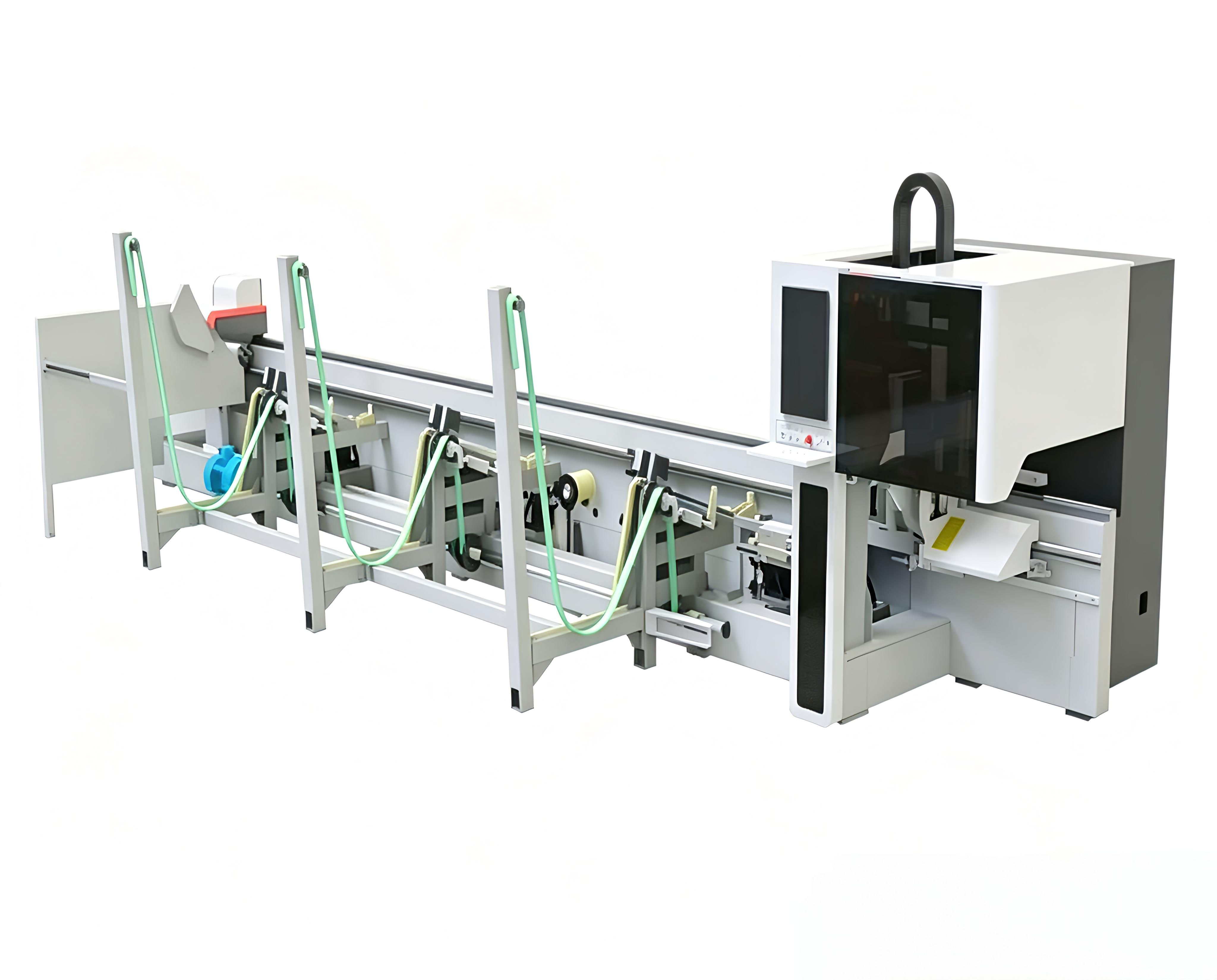
The fully automatic loading system of this machine essentially automates the entire path from the tube rack to the chuck. The rack can hold multiple tubes at once, and the system grabs, feeds, and positions them one by one in a set sequence, then the chuck clamps them for the cutting process. After cutting is completed, the finished product and the tail scrap are automatically separated, and the next pipe immediately enters.
The capacity improvement brought by this process is structural, not merely a matter of increasing the cutting speed:
- Significantly higher proportion of cutting time: During manual loading, the clamping time for a single pipe typically ranges from tens of seconds to several minutes, depending on the pipe diameter and weight.Automatic loading compresses this time to within a few seconds, effectively utilizing the idle time of the machine spindle.
- Enhanced continuous operation capability: Manual loading is limited by the operator's physical strength and requires rest after several hours of continuous work;the automatic loading system has no fatigue curve; as long as the rack has material, the equipment can keep running.
- Batch switching is smoother: When the specifications of pipes in the same batch are consistent, the system continuously feeds materials at a fixed rhythm, eliminating the need for operators to repeatedly adjust the fixture position.
What true unattended operation really means
"Unattended operation" does not mean no human involvement at all, but rather thatthe core cutting process no longer relies on manual intervention. You need to understand its boundaries to determine whether it suits your workshop.
What can be achieved:
- From pipe loading on the rack to cutting completion and tail scrap separation, the entire process requires no manual involvement.
- The 3000W laser power, combined with the CypCut control system, enables continuous execution of large-volume cutting tasks, and the equipment's stability is sufficient to support long-duration operation.
- The tail material length is controlled within 50mm, meaning the usable length of each tube is fully utilized, reducing material waste.
Parts requiring human intervention:
- Material rack replenishment: When the tubes in the material rack are exhausted, manual replenishment is required.The replenishment frequency depends on the cutting cycle time of a single tube and the capacity of the material rack.
- First-piece inspection: When switching to a new tube specification, it is recommended to manually inspect the dimensions and cutting quality after cutting the first piece, and only after confirming correctness should batch continuous production proceed.
- Exception Handling: Although the equipment operates stably, the pipe material itself may have incoming quality issues such as bending or uneven surfaces, which in extreme cases can affect the smoothness of feeding.Such situations are not equipment failures, but occasional issues caused by fluctuations in incoming material quality.
Regarding "Will it frequently jam?": The risk of jamming is mainly related to the straightness and surface quality of the pipe material. If the incoming material is standard straight pipes with no obvious burrs or deformation on the surface, the automatic feeding system can operate stably for a long time. If your incoming material is pipes with significant curvature or special-shaped pipes, it is recommended to first provide pipe samples and specification parameters to the Maidi team to confirm the compatibility of the feeding mechanism with your incoming material, and then evaluate the feasibility of unattended operation.
Who is truly suitable for unattended operation? If your orders involve large batches, relatively fixed specifications, and stable incoming tube quality—such as large-scale automotive pipe fitting production or standard metal furniture component processing—then this equipment can achieve an operational model of "unattended night shifts, daytime material replenishment," shifting labor costs from "operation" to "supervision." If your orders involve multiple varieties, small batches, and frequent specification changes, the benefits of unattended operation will be diluted by changeover time. You need to assess whether the clamping efficiency of automatic loading still outperforms manual labor.
Next step: confirm actions: Provide the Maidi team with your commonly used tube specifications (diameter/side length range, wall thickness, length), batch quantities, incoming material straightness, and your desired daily production capacity targets. Based on this information, they can provide recommendations on rack capacity and estimated cycle time per tube, helping you determine how long unattended operation can sustain continuous production in your scenario.
Which scenarios are suitable for upgrading to a fully automatic tube cutting machine? Which scenarios are not recommended
The core value of a fully automatic tube cutting machine is not "cutting fast," but "cutting continuously without human involvement." To determine whether you are suitable, first look at a key question:Is your order volume stable enough to justify paying for 'unattended operation'?
Three typical scenarios suitable for fully automatic loading
The first: stable batch orders for pipes with high repeatability. For example, there are fixed batches of pipes of the same specification to be processed every month, with infrequent switching between batches. Fully automatic loading saves the time of repeated manual material handling and alignment; the more stable the orders, the more quantifiable the labor cost savings.
The second: cutting cycle time becomes the bottleneck of production capacity, and the shift schedule has already reached two shifts or more. If the existing equipment cannot finish cutting during the day and it is difficult to recruit night shift workers, a fully automatic pipe cutting machine with unattended operation is equivalent to replacing night shift labor with equipment. At this point, the comparison is not about "whether to buy or not," but rather "one year of night shift labor cost vs. the price difference of the equipment."
Third scenario: downstream processes are already automated, and tube cutting is the bottleneck in the production line. For example, if bending, punching, and welding processes are already connected in a line, but cutting still relies on manual loading and unloading, then a fully automatic tube cutting machine fills the gap to complete the automation loop of the entire production line.
When is it not recommended to invest in fully automatic equipment
Scenarios with mixed order types, small batch sizes, and frequent order changes are not recommended. The advantage of fully automatic loading lies in continuous processing of the same batch of tubes;If each batch only has a few dozen pieces and you change materials more than ten times a day, the adjustment time of the loading mechanism will offset the labor saved, making semi-automatic or even manual loading more practical.
Caution is also advised when site space or power supply conditions are limited. The power specification of this equipment is 380V/50Hz, with a total machine power of 24KW. If your region has a 220V/60Hz power supply, the equipment cannot be directly connected and requires an additional transformer or frequency converter.
This is not only a matter of increased procurement costs, but also affects the actual operational stability of the equipment. Before confirming the local power grid modification plan, it is not recommended to place an order directly.
If there is no clear production capacity target, do not upgrade yet. If you merely think "automation is a trend" but cannot clearly articulate which bottleneck you need to solve, it is recommended to first collect data on the current daily output, labor input, and scrap rate of the cutting process, and then assess whether the improvement brought by fully automatic equipment matches its investment.
How to judge the input-output of automation upgrades?Key parameters and decision boundaries
Three key parameters determine suitability.
Tail length: 50mm. This number directly corresponds to material utilization. Taking a 6-meter pipe as an example, each pipe loses about 0.8% in tailings.
If your monthly usage is over 100 tons, reducing the tail from the common 200-300mm to 50mm can yield hundreds of kilograms of usable material each month—this calculation is often more worth considering than the difference in energy consumption of the equipment itself. But if you are using short materials (within 2 meters), the savings from a 50mm tail are limited, and decision-making weight should be given to other factors.
Positioning accuracy: ±0.05mm, repeat positioning accuracy ±0.03mm. The cutting tolerance for automotive pipe fittings (such as oil pipes, exhaust pipes, and structural parts) is generally between ±0.1mm and ±0.3mm, so the accuracy margin of this equipment is sufficient. What really needs to be confirmed is not the precision value itself, but the consistency of your incoming tube materials—if the tubes themselves have significant bending or wall thickness variation, no matter how high the equipment precision is, it cannot compensate.
It is recommended to take 3-5 typical tube types you currently use for sample cutting verification, focusing on the perpendicularity of the cut and the quality of the cross-section.
Laser power: 3000W. The corresponding maximum cutting thickness for carbon steel is approximately 12-16mm (depending on the auxiliary gas and focus position). If your tube wall thickness is generally below 6mm, 3000W is fully sufficient;If you frequently cut thick-walled tubes above 8mm, you need to confirm with the team the actual cutting speed for specific material and thickness combinations, to avoid purchasing power that does not meet the takt time expectations.
When is it worth upgrading, and when is it not
Situations worth upgrading:
- The daily consumption of pipes is stable at over 3 tons, and the order scheduling can fill more than 8 hours of continuous operation.
- Currently, the bottleneck in manual feeding and cutting lies in the loading and unloading process, not in the cutting itself.
- There is dedicated personnel responsible for daily equipment maintenance and simple fault handling (the CypCut system is easy to get started with, but the automated line still requires someone to monitor it).
- The site's electrical conditions are met: 380V/50Hz, with a total machine power of 24KW; it is necessary to confirm the existing transformer's capacity margin.
Situations where upgrading is not worthwhile:
- Orders are mainly multi-variety and small-batch, with material changes exceeding 5 times per day—the advantages of fully automatic feeding will be offset by frequent switching.
- Pipe lengths exceed 6500mm or diameters/side lengths fall outside the 10-120mm range, making it impossible for the equipment to accommodate them.
- The existing workshop cannot be modified to provide the rack space required for automatic feeding (the main machine occupies 8800×2900×2300mm, and space for loading and unloading passages must also be reserved).
- If the budget only covers the equipment itself but not the supporting items (electrical upgrades, material racks, operator training, first-year maintenance), a semi-automatic solution may be a safer choice in this case.
Budget boundary reference: Equipment procurement is only the first step. Installation and commissioning, electrical adaptation (transformers or frequency converters), operator training, and spare parts typically require an additional 15-25% of the equipment price. If the total budget cannot cover these supporting items, it is recommended to first confirm a phased implementation plan with the team rather than forcing a fully automatic configuration.
Frequently Asked Questions
Q: Can the 50mm tail end be achieved for all pipe diameters? A: 50mm is the nominal tail length of the equipment; the actual value is affected by pipe diameter, wall thickness, and clamping method. Large-diameter or thin-walled pipes may require a longer clamping allowance.
It is recommended to conduct actual tests with your most commonly used pipe specifications to confirm.
Q: Is the precision of this equipment sufficient for automotive pipe fitting production? A: The ±0.05mm positioning accuracy is sufficient for the vast majority of automotive pipe fittings (fuel lines, exhaust pipes, seat frame tubes). However, if your product requires weld gap control within ±0.05mm, you need to evaluate the dimensional tolerance of the pipe material itself as well, not just the equipment precision.
Q: Does unattended operation mean no human involvement for 24 hours? A: The equipment can achieve full automation of the entire process including automatic loading, cutting, and unloading, but it is recommended to have at least one person on patrol per shift to handle abnormal situations such as material jams, rack changes, and quality spot checks. True 'unattended' operation requires a well-established production scheduling and material supply system.
Q: Compared with a semi-automatic pipe cutting machine, what does the extra money mainly buy? A: It buys the elimination of the manual loading step. If one worker can handle 1 ton of pipe per hour, fully automatic loading is equivalent to saving the repetitive labor of that position, while reducing collision damage caused by manual handling and loading waiting time.
This calculation is most accurate based on your actual labor cost and working hours.
Q: If production volume increases later, does this equipment have room for expansion? A: The cutting capacity of the equipment itself has redundancy (maximum Y-axis speed 150 m/min), but expansion is mainly reflected at the supporting level—adding more rack quantities, optimizing scheduling logic, and integrating with the production line management system. If you expect production volume to more than double, it is recommended to communicate the overall production line plan with the team in advance.
Learn more
If you are evaluating automation upgrades for tube cutting, it is recommended to start from your own working conditions: record the actual cutting time of the equipment for a week, count the commonly used tube specifications and batch quantities, and confirm the existing power and site conditions.After organizing this information and submitting it to us, we can help you match the material rack capacity solution, estimate the cycle time for a single tube, and provide a reference for input-output calculation tailored to your scenario.
Related products:6012QL-3000W fully automatic loading laser tube cutting machine