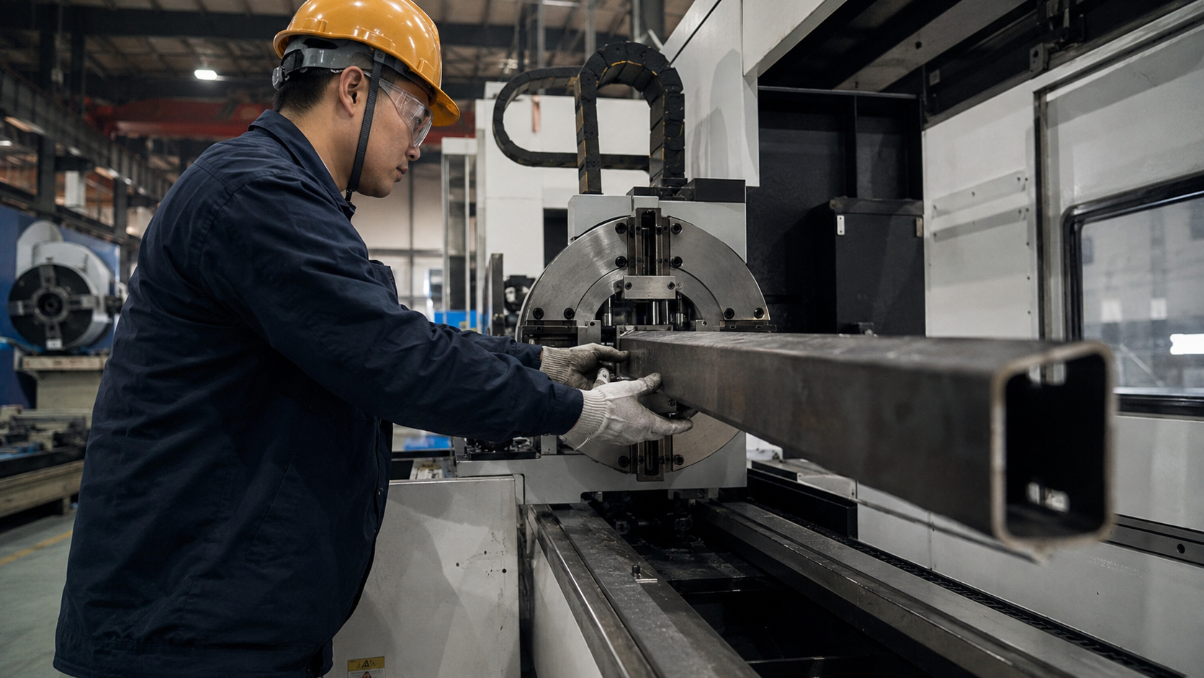
How does this laser tube cutting machine achieve a 50mm ultra-short tail material?
The VIVCNC 6012MYS upgraded laser tube cutting machine controls the tail material to 50mm, which is mainly due to the synergistic design of its core 'front chuck overshoot' function and key equipment parameters.
How does the front chuck overshoot function reduce the final waste?
In traditional cutting modes, the rear clamping chuck occupies a certain length to stabilize the tube, making the end unusable and resulting in longer tail material. The 'front chuck overshoot' function of this equipment changes this process. When cutting the last section of the tube, after completing the feeding and positioning, the front drive chuck continues to move forward to a precisely calculated position (the 'overshoot point').
At this time, the rear chuck has been released, while the laser cutting head can still perform a stable cut on the end of the tube at this extreme position. This design fundamentally compresses the material waste caused by the necessary safety distance of the clamping mechanism.
How do key parameters affect the tail length?
Achieving an ultra-short tail length is a reflection of the equipment's overall performance. Among them,the effective pipe length of 6000mm defines the standard range of pipe materials the equipment can process. And the cutting accuracy of ±0.5mm is the technical foundation for achieving stable over-position cutting.
High-precision servo motor drive and four-axis linkage control system ensure that the equipment maintains trajectory stability and dimensional accuracy even when cutting at the front-end limit position, thereby converting the theoretical short tail material into a stable ultra-short tail material of approximately 50mm in actual production.
How does the 50mm tail material specifically reduce your production costs?
Calculate the saved material costs
Take a standard length pipe of 6 meters (6000mm) as an example for comparative calculation. If traditional processing methods produce approximately 150mm of tail material, and this equipment controls the tail material to 50mm, then each pipe can directly reduce 100mm material waste. For stainless steel or aluminum alloy pipes with higher unit prices, this saving represents a tangible cost reduction.
The estimation can be done with simple multiplication: multiply the 100mm saved per tube by the unit price of the tubing, then multiply by your production batch size to calculate the specific material cost savings.
Impact on Batch Production Efficiency
The efficiency improvement mainly comes from enhanced continuous processing capability. This equipment, throughfront chuck overshoot functionachieves a 50mm ultra-short tail cut, which solves the problem of traditional equipment having to stop for manual removal because the tail is too short to be clamped. In batch cutting, the equipment can operate continuously until the last 50mm, reducing the number of stops, chuck loosening, and manual adjustments, thereby improving the equipment's time utilization and overall output.
This means that within the same amount of time, you can complete the processing of more tubes.
A clear prerequisite is: The realization of this benefit depends on the compatibility of your pipe dimensions and cutting plan with the equipment parameters (such as a cutting thickness ≤3mm).
Which scenarios are suitable for using it to save materials? Which are not?
The ultra-short tail material function of this equipment is designed to reduce material waste, but its value realization is highly dependent on your specific application scenario.
High-value pipes and short material processing are ideal scenarios.
When the processing object ismetal pipes with a higher unit price, such as stainless steel and aluminum alloy.At that time, the 50mm tailstock limit can directly translate into significant raw material cost savings. Especially formetal furniture tube cutting, lighting or decorative tube processingtasks like these that require cutting long tubes into many short pieces, the cumulative reduction in material waste is very significant. In addition, its four-axis linkage function can also well meet high-precision processing needs such as tube intersecting lines.
In which situations might the ultra-short tailstock function not be needed?
In the following scenarios, the priority of pursuing a 50mm ultra-short tailstock may not be high:
- Extremely low material costIf processing inexpensive materials like ordinary carbon steel, the value of a single remnant is very low, making this advantage of the equipment difficult to highlight.
- Process Design Requires Large AllowancesIf your cutting list requires a large process allowance between each workpiece segment (e.g., for welding clamping), the actual remnant length will be much greater than 50mm, and the function cannot be fully utilized.
- Pipe Specifications Exceed Equipment RangePlease note that the effective cutting pipe diameter of this equipment is 15-120mm, with a wall thickness ≤3mm.If you need to frequently process thicker or larger diameter pipes, cutting capability is the primary consideration.
Therefore, before making a decision, it is recommended that you evaluate your commonly usedpipe material, specifications, and typical cutting length combinations.to determine if this function matches your core needs.
How to determine if you truly need the 'ultra-short tail' function during evaluation?
When evaluating whether to invest in the 'ultra-short tail' function, the key is to translate this function into a clear return on investment for you. This requires a practical evaluation framework.
Evaluate your current scrap rate and material costs
First, please quantify your current waste. This is a simple self-check step:
- Measure the tail materialCount the common scrap head lengths in your production.If they are generally over 200mm, there is significant potential to shorten them to 50mm.
- Calculate CostUse(Length shortened per pipe × Pipe cross-sectional area × Material unit price) to calculate the cost saved per pipe, then multiply by annual consumption to estimate the potential annual material savings.
- Review Waste CompositionIf your main waste comes from 'intermediate offcuts' during the cutting process rather than pipe ends, the benefits of tail-end optimization will be very limited.
Weighing the Trade-offs Between Traditional Equipment and Upgrade Solutions
Next, please assess the solution's suitability based on your production needs:
- Scenarios More Inclined Towards UpgradingWhen you are performingbatch, uniform-specificationcutting (e.g., for metal furniture, standard structural components), and the material unit cost is high, the VIVCNC 6012MYS's50mm ultra-short tail materialand±0.5mm precisioncan be directly converted into material and quality benefits.
- Scenarios requiring careful evaluation: If you often process pipes with wall thickness exceeding 3mm, pipe diameter significantly larger than 120mm, or if material costs account for a relatively low proportion, the urgency of this upgrade is not high.
The clear decision recommendation is: Inform the Qingtian Intelligent Manufacturing team of your most typical pipe specifications, cutting drawings, and annual usage, and request a precise cost simulation calculation. This is the completion ofEquipment Selection GuideandReturn on Investment AssessmentThe most reliable step.
If your scrap cost is indeed a core pain point and the calculated return is clear, then this feature is worth key consideration.
Frequently Asked Questions
Q: How exactly is the 50mm tail material achieved? Will it affect cutting precision? A: This mainly relies on the equipment's standard configuration offront chuck overshoot function。
It allows the clamping mechanism to move forward before the end of the cut, enabling the laser to cut close to the fixture, thereby minimizing the remaining tail material. This process is precisely controlled by a four-axis linkage system, with the design goal of achieving ultra-short tailings while maintaining a cutting precision of ±0.5mm.
Q: If my material isn't expensive, do I not need this feature? A: Material unit price is one of the core variables. When material costs are low, the economic benefit of saving tailings may not cover the investment in equipment upgrades.
At this point, you should evaluate whether the upgrade brings other significant value in terms of precision, efficiency, or reduction of subsequent processes.
Q: How is the return on investment period generally estimated? A: In addition to calculating material savings, efficiency and quality benefits should also be considered. When having the Qingtian Intelligent Manufacturing team conduct the calculation, you can request a comprehensive assessment that includes:(Monthly Material Savings + Potential Efficiency Improvement Value) Payback period after amortizing the equipment price difference.
Q: Is this function effective for all pipes? What are the risk boundaries? A: According to the product parameters, it is mainly applicable toround and square pipes with wall thickness ≤3mm and pipe diameter 15-120mm.round tubes and square tubes.
For heavy-duty pipes exceeding these specifications, the cutting capability may be limited. This is a clear usage boundary that must be confirmed during model selection.
Learn More
If, after evaluation, you find that the 50mm ultra-short tail material function meets your production needs, please feel free to contact the Qingtian Intelligent Manufacturing team. Submit your pipe specifications, cutting plan, and annual usage to receive an exclusive cost simulation and equipment compatibility analysis.Let us work together to find a more cost-effective solution for your production.
Related Products:6012MYS Upgraded Square-Round Integrated Laser Pipe Cutting Machine