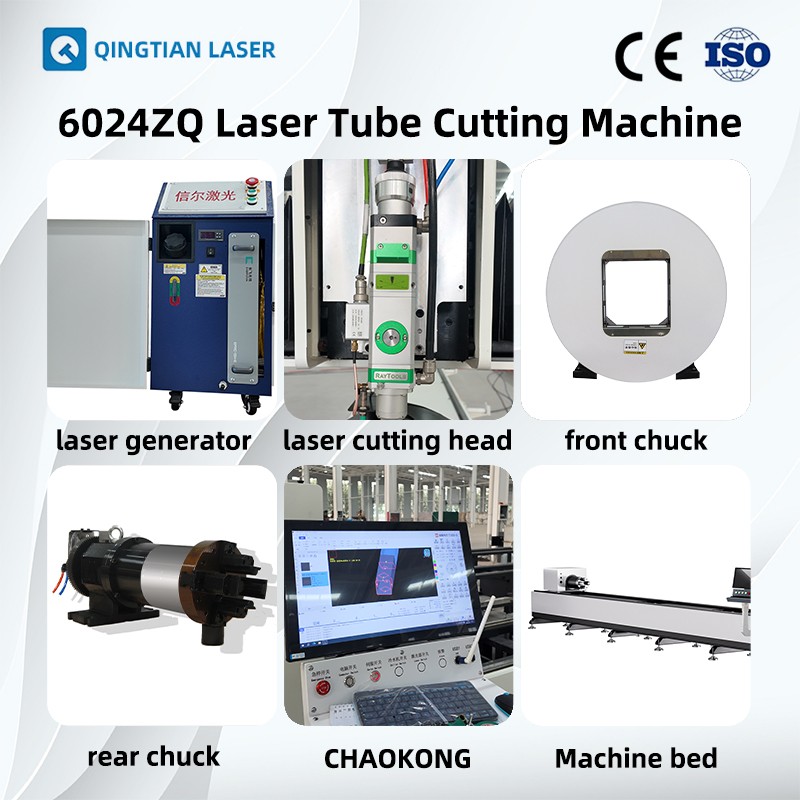
What exactly can a 1500W fiber laser tube cutting machine cut: first look at the thickness boundary of 0-10mm
This mini economical fiber laser tube cutting machine processes small-diameter round tubes and square tubes, and performs three types of work: 2D cutting, hole drilling, and cutting off. It handles the process segment of "tube blanking + tube body hole drilling" and does not involve 3D special-shaped tubes or large-diameter processing.
What is a mini economical fiber laser tube cutting machine: 2D cutting, hole drilling, and cutting off of small-diameter round tubes and square tubes
The equipment uses a fiber laser, 1500W power, 4-axis configuration, Fangling control system, Raytools laser head, liquid cooling, and continuous wave output. Applicable materials cover steel, aluminum, metal, stainless steel, and iron. Typical scenarios include stainless steel round tube and square tube cutting, guardrail post blanking, metal furniture tube processing, and advertising frame production — the common points are small diameter, multiple specifications, and flexible batch production.
1500W and 0-10mm cutting thickness: what does putting these two parameters together mean
1500 watts is the given power, and 0-10mm is the given cutting thickness range; together they form the capability boundary of this equipment. 7000-8000mm/min is the given speed range. Whether this speed can be maintained for a specific material and thickness is not elaborated in the materials and needs to be confirmed based on the actual pipe.
When judging suitability, first check whether the wall thickness of the pipes you commonly cut falls within 0-10mm. The closer to thin walls, the more efficiency can be brought into play;the closer to 10mm, the more speed and cross-section quality need to be verified in practice. In terms of materials, steel, aluminum, stainless steel, and iron are all within the applicable range, but different materials respond differently to the same power, so the cutting performance of a certain material cannot be inferred from the power figure alone.
Conclusion: If your orders are mainly small-diameter round pipes and square pipes, with wall thicknesses concentrated within 0-10mm, the capability boundary of this equipment matches your needs;if you process thick-walled pipes close to 10mm for a long time or have high requirements for cycle time, it is recommended to first confirm the actual cutting performance before deciding.
Derive power from your own pipe thickness: three steps to determine whether 1500 watts matches your order
"Should I just go straight to higher power?" This question is asked backwards. Is 1500 watts enoughIt depends on the pipe thickness you commonly cut and your order rhythm, not on the size of the numbers in the equipment parameter table.
Step one: tally the material and thickness range of the pipes you commonly cut, rather than looking at what power rating your peers bought.
A peer may have bought 3000 watts because they take on thick-walled industrial pipes;If you take on guardrail posts, metal furniture, and advertising frames, the pipe wall is often in the thin-sheet range. List the materials and wall thicknesses of your most recent twenty or thirty orders, and find the thickness range that appears most frequently—this range is theBasis for judging the matching of pipe thickness and power.The basis for judgment.
Step 2: Match the thickness range with 0-10mm and 7000-8000mm/min to determine whether the cycle time is sufficient.
This mini economical fiber laser pipe cutting machine has a cutting thickness of 0-10mm and a cutting speed of 7000-8000mm/min, and is suitable for materials such as steel, aluminum, stainless steel, and iron. The judgment method is very direct:
- If the commonly cut thickness is concentrated in the middle-to-lower part of the range, and the single-batch quantity is not large with frequent model changes—the cycle time of 1500 watts is usually sufficient.
- If the commonly cut thickness remains close to the upper limit of the range for a long time, or orders are mainly thick-walled and large-batch—the cutting speed will drop significantly. At this point, it is not a question of "whether it can cut," but of "how many pieces are produced per unit time."
When the thickness or cycle time exceeds the given range, working condition information should be supplemented, and the QingTian team will assist in confirming the power or customized configuration plan. When the standard configuration can cover the main orders, paying for power beyond actual needs is usually not cost-effective.
Situations suitable for 1500 watts: 2D cutting, hole making, and severing of small-diameter round tubes and square tubes, mainly in stainless steel, steel, and iron, with thickness concentrated in the low-to-medium range, many order specifications, small batches, and frequent changeovers.
Situations requiring caution: Long-term focus on thick-walled tubes close to 10 mm, or large single batches with tight delivery deadlines. Such orders are not "unusable" with 1500 watts, but the cycle time may become a bottleneck.
Which scenarios 1500 watts is sufficient for and which it is not: suitability assessment for guardrail posts, metal furniture, and advertising frames
Whether 1500 watts is enough does not depend on the industry name, but on the tube wall thickness, diameter, and daily workload. This mini economical fiber laser tube cutting machine has a clear positioning: two-dimensional cutting, hole opening, and cutting off of small-diameter round tubes and square tubes, with a cutting thickness of 0-10mm. Breaking down three typical scenarios makes the judgment much clearer.
Recommended scenarios: cutting off and hole opening for small-diameter round tubes and square tubes, batch blanking within a thickness of 0-10mm
Guardrail post blanking, metal furniture tube processing, and advertising frame production share the same characteristics: relatively small tube diameters, mainly cutting off and hole opening, which fall exactly within the applicable range of the equipment:
- Guardrail post blanking: batch cutting off, requiring consistent length and flat cuts, a typical square tube and round tube cutting process.
- Metal furniture tube processing: table legs, chair frames, etc. The common actions are fixed-length cutting plus hole opening, which two-dimensional cutting can cover.
- Advertising frame production: Specifications are varied and there are many single pieces, requiring frequent size changes. For small-diameter tubing, rapid changeover is more important than high power.
The judgment criterion can be simplified into one sentence:For pipe wall thickness within 0-10mm, mainly round pipes and square pipes, and requiring hole drilling and cutting, 1500 watts is enough.
Scenarios not recommended or requiring confirmation: exceeding 0-10mm thickness, having higher requirements for cycle time, or frequent and significant changes in pipe specifications
Do not only look at the upper limit number of "10mm"; the actual cutting capability will vary with material, pipe diameter, and cutting quality requirements. In the following situations, it is recommended to confirm first rather than place an order directly:
- Wall thickness close to or exceeding 10mm: 0-10mm is the nominal cutting thickness. When thick-walled pipes approach the upper limit, both cutting speed and cross-section quality will decline. It is necessary to confirm whether stable processing can be achieved based on the actual material and thickness.
- Have higher requirements for cycle time: When order volumes are large and the required time per piece is extremely short, the speed upper limit of 1500 watts will become a bottleneck, and a higher power configuration needs to be evaluated.
- Pipe specifications change frequently and significantly: Occasional changeovers are not a problem, but if switching back and forth between large and small pipe diameters every day, it is necessary to confirm whether the fixture and stroke can cover the maximum pipe diameter.
Budget allocation should be developed around the pipe material and thickness of one's own orders: first confirm whether the standard configuration can cover the main orders, then evaluate whether customization is needed. Specific prices and customization scope are subject to confirmation by the product provider.
Is it cost-effective to pay for power beyond actual needs: the boundary between choosing standard configuration and customization
There is only one criterion for judgment:whether your main orders fall within the capability range of the standard configuration.
When to choose the standard 1500-watt configuration: thickness and cycle time are both within the given range
When pipe wall thickness is concentrated at 0–10 mm, the required cutting speed is within 7000–8000 mm/min, and small-diameter round pipes and square pipes are the main focus, the standard 1500-watt configuration is sufficient. In such scenarios, reserving the budget for long-term expenses such as operating costs, replacement parts, and installation training is more cost-effective than spending extra on higher power. Fiber laser has high electro-optical conversion efficiency and low operating costs, and its adjustment-free and maintenance-free structure reduces the burden of daily adjustments—but routine cleaning and inspection are still necessary.
When it is worth considering power or configuration customization: thickness, speed, or pipe specifications exceed the given range
When wall thickness remains close to or exceeds 10 mm for a long time, the cycle time requirement exceeds 7000–8000 mm/min, or pipe specifications exceed the small-diameter range, the standard configuration will become a bottleneck, and only then is it worth discussing power configuration customization. Whether customization is supported and the scope of customization must be confirmed with the QingTian team after providing the pipe material, wall thickness, cross-section dimensions, and daily output; it is not advisable to assume on your own that it can be upgraded to any power.
Conclusion: When the standard configuration can cover the main orders, give priority to the standard configuration;only when wall thickness, speed, or specifications continuously exceed the given range should customization discussions begin. Specific prices, customization surcharges, and delivery times are subject to confirmation by the QingTian team.
Frequently Asked Questions
Q: Can this mini pipe cutting machine be customized in power or configuration according to my pipe requirements? Needs confirmation. Depending on your pipe material, wall thickness, cross-sectional dimensions, and output, it is recommended that you organize the information and verify it directly with the QingTian team.
Q: Is 1500 watts just enough to cut 10mm? 10mm is the nominal upper limit; operating close to the upper limit for a long time will squeeze efficiency and stability. If orders frequently approach this thickness, this should be used as the core basis for deciding whether to customize.
Q: If I occasionally cut a batch of thick pipe, is it worth paying extra to customize for it? Usually not worth it. Occasional needs can be handled through outsourcing, which is more reasonable than making the entire machine pay for low-frequency working conditions.
Q: Will maintenance be more troublesome after customization? The more complex the configuration, the higher the subsequent maintenance and spare parts costs usually are. One of the advantages of a conventional configuration is precisely that it requires no adjustment and no maintenance, and has low spare parts costs. Before adding configurations, long-term costs should be factored in as well.
Learn more
If you are selecting pipe cutting equipment, rather than struggling over the size of the power number, it is better to first sort out the material, wall thickness, cross-sectional dimensions, and daily output of the pipes you commonly cut.Submit this working condition information to the QingTian team, and we can help you determine whether the conventional configuration of the mini economical fiber laser pipe cutting machine covers your main orders, and whether a customized solution needs to be discussed further.