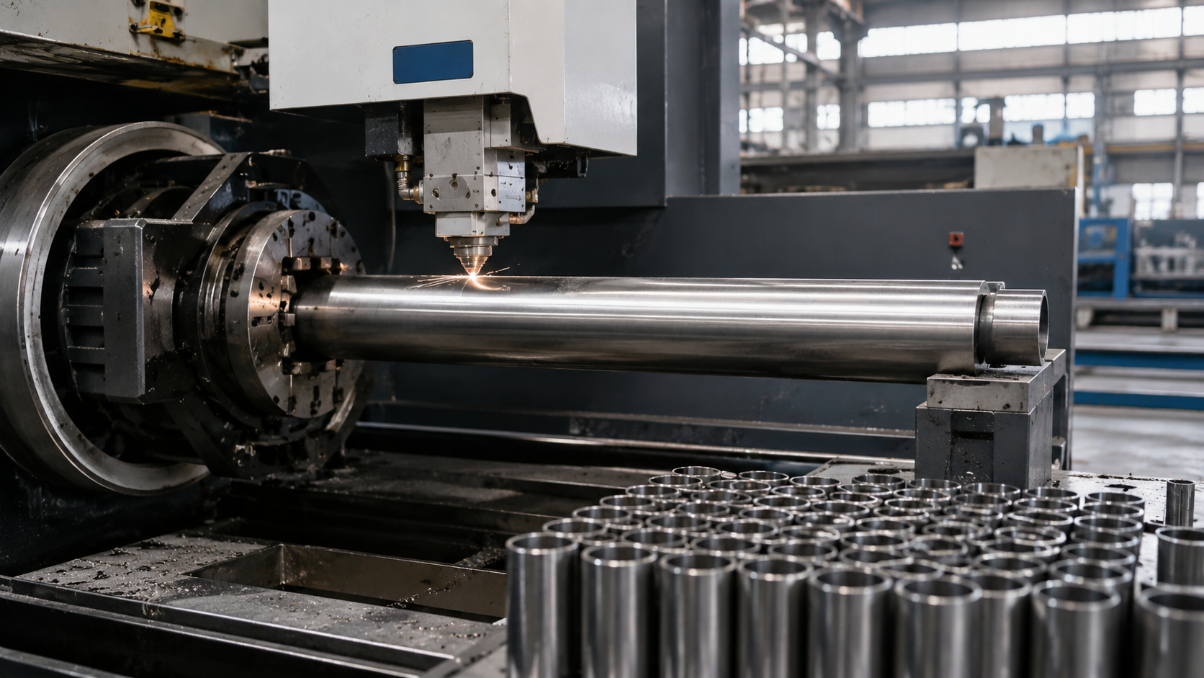
VIVCNC 6012MYS Laser Tube Cutting Machine: How Does Four-Axis Linkage Define High Precision?
In tube processing, cutting precision is not only about edge smoothness but also determines the accuracy of the three-dimensional trajectory, which is crucial for subsequent welding and assembly. The VIVCNC 6012MYS upgraded version addresses this need throughhigh-precision four-axis linkagedesign.
What is four-axis linkage cutting technology?
Traditional laser tube cutting machines typically use three-axis linkage (X, Y, Z axes) to control the movement and focusing of the laser head within a plane. Four-axis linkage adds a fourthRotary axis. This means that during operation, the three linear axes work in coordination with the rotary axis,allowing simultaneous control of the laser head's movement and precise rotation of the tube.。
This technology is a fundamental requirement for processing spatial trajectories such as intersecting lines on round tubes and complex curve openings.
How does the 6012MYS achieve a cutting accuracy of ±0.5mm?
Thislaser tube cutting machineachieves±0.5mm cutting precision, is a reflection of comprehensive system capabilities:
- Drive CoreIt uses Hechuan servo motors to provide stable and precise motion control for the four axes, which is the fundamental guarantee for precision.
- Physical ClampingThe front and rear pneumatic chucks can firmly clamp the pipe, effectively reducing vibration and displacement during high-speed cutting.
It should be noted that ±0.5mm is the design precision under ideal operating conditions. The actual cutting effect is also influenced by factors such as pipe material, wall thickness, and process parameters.
Here is the basis for your initial judgment: If your processing involves square/round pipes with diameters of 15-120mm and thicknesses ≤3mm, and requires high-precision spatial trajectory cutting (such as intersecting lines), the four-axis linkage design of the 6012MYS is the technical starting point to meet such needs.
How does four-axis precision solve the error challenges in pipe intersecting line processing?
Traditional pain points and precision requirements in intersecting line processing
A pipe intersecting line is a complex spatial curve formed by the intersection of two or more pipes, and its processing precision directly determines the subsequent welding quality and structural strength. Traditional processing methods, such as manual marking or ordinary cutting equipment, have large errors, which can easily lead to groove angle deviations and uneven interface gaps, thereby increasing the workload for welding filling and correction, and even causing internal stress problems.
How high-precision cutting reduces welding and assembly errors
The 6012MYS laser pipe cutting machine adopts a four-axis linkage design, with a cutting precision of ±0.5mm, capable of accurately completing the three-dimensional trajectory cutting of complex intersecting lines. High precision ensures consistent bevel formation, reduces fit-up gap errors before welding, thereby lowering welding difficulty and time consumption, and improving weld seam stability. At the same time, precise cuts enable smoother component assembly, reduce on-site adjustments, and are suitable for complex pipe precision machining scenarios.
This equipment can process intersecting lines for pipe diameters of 15-120mm and wall thicknesses ≤3mm. Please confirm specific parameters before selection to match its capabilities.
Which production scenarios are suitable for selecting a high-precision four-axis laser pipe cutting machine?
Choosing this high-precision four-axis laser pipe cutting machine (6012MYS upgraded version) hinges on whether your production tasks match its ±0.5mm precision, its four-axis linkage capability for handling complex trajectories, and its cutting thickness limit of ≤3mm.
Recommended Scenarios: High-precision, complex trajectory metal pipe processing
The following scenarios can fully leverage its technical advantages:
- Precision structural parts and assembly components processingFor example, special-shaped connecting pipe fittings for metal furniture, display racks, sports equipment, etc.These components require high-precision intersecting line cutting and dimensional control. Four-axis linkage can form them in one pass, ensuring assembly quality.
- Batch production with strict requirements for material utilizationWhen cutting high-unit-price pipes like stainless steel or aluminum alloy, the equipment's feature of 'tail material only 50mm' can directly reduce material consumption costs. The front clamp overtravel function supports this.
- Workpieces requiring complex cuts to be completed in one passIf the workpiece has bevels, arc openings, or special hole shapes, traditional multi-process machining is inefficient and inconsistent. This equipment can efficiently complete the cutting in one pass.
Not recommended scenarios: simple straight-line cutting or occasions with no strict requirements for precision
If your needs are mainly simple fixed-length straight-line cutting, or if the requirements for cut precision and finish are not high (e.g., internal structural parts, or subsequent extensive grinding processes), then choosing this high-precision equipment may lead to a mismatch between performance and budget. A more economical entry-level laser cutting machine or CNC saw might be more suitable for such needs.
Directly addressing your question:
- Is it suitable for cutting tubes for metal furniture? It is suitable for furniture tubes made of stainless steel and similar materials that require complex designs, high precision, and aesthetically pleasing cuts.It is not necessary for furniture with simple structures that primarily involve straight-line joining.
- If the processing needs are simple, is it necessary to buy this type of equipment? Generally not recommended. If the need is limited to low-precision straight-line cutting, investing in this equipment is not the most cost-effective choice. It is recommended to assess whether future needs will escalate to complex precision machining before making a decision.
How to determine if the four-axis linkage precision meets your production standards?
When choosing a laser tube cutting machine, the most critical factor is to judge whether its core parameters match your specific production needs. The following is a judgment approach based on the parameters of the upgraded Mid 6012MYS equipment.
Interpreting Key Parameters: Cutting Precision, Tube Diameter, and Wall Thickness
The equipment's nominal "Cutting Precision ±0.5mm" means that under standard cutting conditions, the deviation between the cutting size and the programmed path can be controlled within plus or minus 0.5 millimeters. This is sufficient for the vast majoritystructural components and furniture tube cuttingprecision requirements. However, if your product involvesprecision assembly or has stringent appearance standards,you need to compare this precision with your drawing tolerance requirements.
"Effective cutting tube diameter 15-120mm" and "Cutting thickness ≤ 3mm" Defines the material boundary the equipment can process. You need to confirm:
- your pipe'souter diameteris within this range (for example, a 14mm or 130mm pipe will not be processable).
- your pipe'swall thicknessexceeds 3mm, as excessive thickness will affect cutting quality and efficiency.
From Requirements to Selection: The Next Step in Consultation and Confirmation
After understanding the meaning of the equipment parameters, you can confirm the match through the following steps:
- Self-Check ListCheck your product drawing tolerance requirements, the material of commonly used pipes (such as stainless steel, carbon steel), and the precise outer diameter and wall thickness.
- Clarify RequirementsConfirm whether complex trajectories such as intersecting lines need to be cut, and whether there are requirements for the tail length (this equipment comes standard with a front chuck overrun feature, which can achieve an ultra-short tail of about 50mm, helping to save valuable pipe materials).
- Consultation and ConfirmationWhen your requirements exceed the conventional range or you have special requirements for cutting quality, it is recommended to directly contact the Qingtian Intelligent Manufacturing team. Please prepare yourproduct drawings or a detailed description of the workpiece's intended use, so that our engineers can provide you with the final fitting solution.
Frequently Asked Questions
Q1: Is a precision of ±0.5mm sufficient for processing my stainless steel decorative tubes? A1: This depends on your definition of 'precision'. For most decorative installations, a precision of ±0.5mm can ensure a good appearance and smooth assembly.
However, if your decorative parts need to fit with precision injection-molded components or other high-precision parts, we recommend you bring physical samples or drawing specifications to discuss and evaluate the specifics with our technical personnel.
Q2: My pipe's outer diameter is 125mm. Although it only exceeds the limit by 5mm, can it be cut using other methods? A2: The effective cutting pipe diameter of the equipment is clearly 15-120mm. Pipes outside this range cannot be cut with confidence for normal operation of the cutting head and precision. Forced processing carries risks.
For such non-standard specifications, we recommend you provide detailed information, and we can explore whether other models or customized solutions are available.
Q3: The equipment cuts thicknesses ≤3mm. If I occasionally need to process 3.5mm pipes, will there be a problem? A3: The "≤3mm" in the parameters is a recommended stable working range. When cutting pipes with thickness approaching or slightly exceeding the upper limit, it may be necessary to adjust the cutting process parameters, and the cutting speed and cross-section quality may be affected.
For materials exceeding the nominal thickness, it is strongly recommended to consult in advance to confirm whether it is within the stable processing capability of the equipment.
Q4: What specific information do I need to prepare during the consultation to get the most accurate solution recommendation? A4: To improve communication efficiency, please provide as much of the following as possible: 1) The specific material of the pipes;2) The precise outer diameter and wall thickness range of the most commonly used pipes;3) Drawings or sample photos of the workpieces;4) Any special requirements for cutting precision, efficiency, or tail length. This information will help us quickly determine if the equipment fully meets your production standards.
Learn More
Every production scenario has its unique characteristics.If you have initially determined that the four-axis linkage and precision capabilities of the 6012MYS upgraded version meet your requirements, or if you have higher expectations for existing complex pipe processing solutions, please provide yourworkpiece drawings or sample photosto our technical team.We will analyze the specific adaptation plan based on this and provide a more detailed quotation and technical support.
Related products:6012MYS Upgraded Version Square-Round Integrated Laser Pipe Cutting Machine