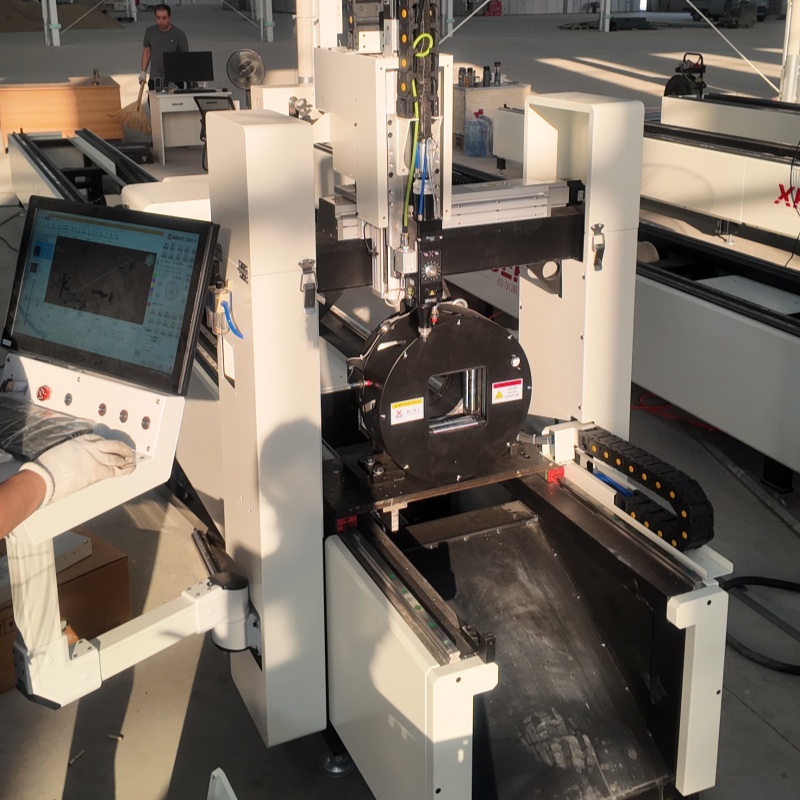
What is a mini economical fiber laser tube cutting machine: The economical positioning comes from configuration trade-offs, not from lowering the standards of key components.
The mini economical fiber laser tube cutting machine is a device that narrows the processing range to 2D cutting, hole opening, and cutting off of small-diameter round tubes and square tubes, rather than a "shrunken machine" that replaces core components with cheap substitutes. Its economy comes from two trade-offs: first, it only performs 2D processing of tubes and does not pursue multi-axis linkage and complex 3D beveling;second, the machine body is compact and occupies little space, making it suitable for the limited sites of individual operators and small factories. In terms of core configuration, it still uses a fiber laser, Raytools laser head, Fangling control system, and liquid cooling system, with 1500 W power, 4 axes, 0-10 mm cutting thickness, and 7000-8000 mm/min cutting speed. This combination supports stable output during long-term continuous operation, rather than low price and low quality.
Where is the difference between it and "low-quality equipment": start by looking at the core components.
To judge whether an economical tube cutting machine compromises on key components, it is enough to look at three things: the type of laser, the brand of the laser head, and the brand of the control system. This equipment uses a fiber laser, which has high electro-optical conversion efficiency and low operating cost;The laser head is Raytools, and the control system is Fangling—these two directly determine cutting accuracy and long-term stability. If the economic positioning is achieved by replacing these components, cutting quality will fluctuate noticeably with use over time, and maintenance frequency will also increase.
Its trade-offs occur in processing range and machine size, not in these components that determine whether it can cut stably.
What do these parameters—1500 watts, 0-10mm, 4-axis—mean for stability?
1500 watts paired with a 0-10mm cutting thickness covers the common wall thickness range of small-diameter round pipes and square tubes. It is a configuration where power matches the processing object, and it does not need to run overloaded to barely cut through. The 4-axis corresponds to the three types of actions: two-dimensional cutting, hole opening, and cutting off. A simple structure means fewer failure points and greater room for adjustment-free and maintenance-free operation. The liquid cooling system allows the equipment to operate continuously for long periods, rather than cutting for a while and then stopping.
The cutting speed of 7000-8000mm/min leaves margin for batch or single-piece custom scenarios such as guardrail post cutting, metal furniture tubing, and advertising frames.
Who it suits: Individual hardware processing operators, small metal product factories, and pipe processing entrepreneurs whose orders are mainly small-diameter round pipes and square tubes, with many specifications and small batches, limited startup capital and space, and who need to start taking orders quickly.
Who it does not suit: Scenarios requiring 3D cutting, large-diameter thick-walled pipes, complex bevels, or high-frequency changeover of heavy pipes—such needs exceed its processing range. This is not a stability issue, but a capability boundary issue.
What to confirm next: Tell the QingTian team your pipe material, maximum pipe diameter, common wall thickness, and daily processing volume to confirm whether this equipment covers your main orders;At the same time, ask clearly about installation, commissioning, and operation training arrangements, as well as the laser service life and maintenance costs. These two items directly affect your actual operating expenses after getting started.
How to verify stability: look at long-term performance from the liquid cooling system, continuous operation capability, and adjustment-free design
The most easily doubted aspect of a "mini economical" model is whether it will falter after several hours of continuous operation. To judge stability, don't look at promotional slogans; look at three verifiable dimensions: cooling method, operating mode, and routine maintenance workload.
How the liquid cooling system and continuous wave mode support long-term continuous operation
Fiber lasers have high electro-optical conversion efficiency, but the remaining energy is still converted into heat. Heat accumulation directly affects the quality of the cut end face and the consistency of power output. This device uses liquid cooling and works with a continuous wave operating mode, meaning it is designed for the working condition of "continuous light emission, continuous cutting," rather than only short bursts.
For tasks such as cutting guardrail posts to length and batch cutting metal furniture tubing that require running dozens or hundreds of tubes in one go, liquid cooling is a prerequisite for continuous operation, not an add-on feature.
During verification, you can directly ask: after how long of continuous cutting does it need to stop for cooling? What is the allowable fluctuation range for the cooling water temperature? These two questions reveal actual continuous operation capability better than whether liquid cooling is present.
The boundaries of adjustment-free and maintenance-free: what still requires routine cleaning and inspection
"Adjustment-free and maintenance-free" means the optical path requires no manual calibration and no frequent replacement of wearing optical components; this is a structural advantage of fiber lasers compared with other types. But it does not equal zero maintenance. What still needs to be done regularly in actual use: cleaning dust and dross produced by cutting, checking coolant level and cleanliness, and confirming whether the protective lens is contaminated.
These are routine cleaning tasks, not precision adjustments; self-employed individuals can complete them on their own without the manufacturer coming on site.
If what you expect is "buy it and completely ignore it," then no laser equipment meets that expectation;If you can accept spending a dozen or so minutes each week on cleaning checks, the maintenance burden of this device falls within a reasonable range.
Judgment recommendation: If orders are mainly small-diameter round tubes and square tubes, with continuous operation for several hours each day, and you are willing to do basic cleaning—you can be confident in the stability dimension. If you need 24-hour nonstop operation, or processing thick-walled large-diameter tubes, you should focus on continuous operation duration and cooling margin, and confirm with the QingTian team the performance under specific working conditions, rather than drawing conclusions based only on the words "liquid cooling."
Which scenarios can verify stability: real working conditions such as stainless steel round tube and square tube cutting, guardrail post cutting
Stability cannot be seen from a parameter table; it must be verified in specific working conditions. For this mini economical fiber laser tube cutting machine, the three most direct verification scenarios are: stainless steel round tube and square tube cutting, guardrail post cutting, and metal furniture and advertising frame tube processing. Their common feature is that the tube diameter is relatively small, mainly involving 2D cutting/punching/cutting off, which falls exactly within the applicable range of the equipment.
Small-diameter round and square tube cutting and hole drilling with cut-off: how single clamping reduces cumulative error
To judge stability, first see whether hole drilling and cut-off can be completed in one clamping. If the same tube needs to be drilled and then cut off, secondary clamping is required, and each repositioning introduces deviation, which becomes more obvious as the batch size increases. This equipment has a 4-axis configuration and supports 2D cutting, hole drilling, and cut-off, meaning that multiple processes on the same small-diameter round or square tube can be completed within one clamping, and errors will not accumulate with the processes.
When verifying, it is recommended to test with your own actual tube parts: drill a set of holes on the same tube and then cut it off, doing more than 20 pieces continuously, and see whether the hole positions and cut surfaces remain stable and consistent. This is more telling than looking at a single sample.
Guardrail post cutting and metal furniture tube processing: batch consistency and changeover flexibility
The core requirement for guardrail post cutting is consistent length and flat cut surfaces, which is a typical batch cut-off process. Metal furniture and advertising frames are the opposite—many specifications, many one-off customizations, and what is tested is changeover speed. These two types of demand seem contradictory, but they both point to the same thing: whether the equipment can maintain stable output during continuous operation.
The equipment is equipped with a liquid cooling system and supports continuous wave mode, allowing long-term continuous operation, which is necessary for batch cutting. But "being able to run continuously" and "running stably" are two different things. It is recommended to run continuously for a period of time during verification and observe whether the cut quality drifts over time.
Is 1500 watts enough for cutting 0-10mm stainless steel round tubes and square tubes?
This is the most frequently asked question. The equipment has a nominal cutting thickness of 0-10mm and a 1500-watt fiber laser. What needs to be made clear is that 0-10mm is the applicable thickness range of the equipment, which does not mean that all thicknesses within this range can achieve the same cutting speed and cross-section quality.
Thin-walled tubes (such as the 1-3mm commonly used for furniture and advertising frames) usually have high cutting efficiency and good cross-sections;For thick-walled tubes approaching 10mm, the cutting speed and cross-section quality will noticeably decrease, and whether this is acceptable depends on your requirements for efficiency and end-face smoothness.
The common wall thicknesses of guardrail posts and furniture tubing mostly fall within the medium-to-thin wall range, and this machine is a match. But if you often cut stainless steel near the upper thickness limit, it is recommended that you provide the specific material, wall thickness, and average daily output to the QingTian team to confirm the actual cutting performance, rather than drawing conclusions based only on the "0-10mm" range.
Suitable and Not Suitable
Suitable: hole drilling and cut-off processing of small-diameter round and square tubes;batch cutting of guardrail posts;Multi-specification, small-batch tube processing for metal furniture and advertising frames;Entrepreneurs with limited site and startup budgets who need one machine to cover a variety of small tube parts.
Need to first confirm: scenarios where thick-walled stainless steel close to 10mm is frequently cut;scenarios with extremely high requirements for the finish of the cut end face;processing where the tube diameter exceeds the small-diameter range. In these cases, it is recommended to first provide the specific working conditions to the QingTian team for evaluation, to confirm whether they are within the machine's capability boundaries.
Who is recommended and who is not: the selection boundaries and decision conclusions for economical tube cutting machines
Recommended scenarios: processing businesses with order thickness of 0-10mm, mainly small-diameter pipes, and limited budgets
If the work you have on hand is concentrated intwo-dimensional cutting, hole drilling, and cutting off of stainless steel round pipes and square pipes, the pipe diameter is not large, the wall thickness is basically within 0-10mm, and orders show the characteristics of "many specifications, small batches, and frequent changeovers," this mini economical fiber laser pipe cutting machine is a suitable starting choice. In scenarios such as cutting guardrail posts, processing metal furniture pipes, and making advertising frames, the demand is essentially consistent length, flat cuts, and stable hole positions, rather than extreme speed or extra-large pipe diameters, and the machine's capability boundary exactly covers this.
For self-employed individuals and startup small factories with limited budgets, limited space, and who are just beginning to take orders, the priority is "how many kinds of work one machine can cover," not "how low the cycle time per piece can be pressed." A 1500W fiber laser paired with 4 axes and liquid cooling for continuous operation is sufficient for daily continuous processing of small-diameter pipes, and being adjustment-free and maintenance-free also lowers the entry threshold when there is no dedicated technician.
Not recommended scenarios: ultra-thick pipes, extra-large pipe diameters, or production lines with extremely high cycle time requirements
In the following situations, this machine is not recommended—not because of quality issues, but because its capabilities do not match the requirements:
- Wall thickness consistently exceeds 10mm: This exceeds the nominal cutting thickness. Forcing it will only sacrifice cut quality and efficiency.
- Pipe diameter is relatively large or the cross-section is mainly irregular: This machine is positioned for 2D processing of small-diameter round pipes and square tubes. Large pipe diameters or complex 3D cutting are outside its coverage.
- Production line takt time requirements are extremely high and need automatic connection with upstream and downstream: A standalone economical solution will become a bottleneck in continuous high-takt, automated line-connected scenarios. For such needs, you should directly look at more complete production-line-level solutions.
- Expected results are still changing frequently: If even the main processing objects and batch structure are not yet determined, don't buy it yet—first get a clear picture of your order structure.
Should you buy it, or keep using a sawing machine and manual cutting?
The criterion is not "laser is definitely better than a sawing machine," but ratherwhether your orders have already made the sawing machine and manual work a bottleneck。 If the following signals appear, upgrading to this machine is usually worthwhile: cuts require subsequent grinding, hole-making needs a separate process, specifications in the same batch keep changing and cause workers to repeatedly reset the tool, and delivery deadlines are often held up at the cutting stage. Conversely, if order volume is small, specifications are uniform, and requirements for cut precision are not high, continuing with your existing method is actually more economical.
Final conclusion
If your orders are mainly small-diameter pipes, wall thickness is 0-10mm, your budget is limited, and you need a starter machine that can quickly handle a variety of jobs—choose it. Ultra-thick, ultra-large pipe diameter, high-takt production lines, or requirements that haven't been finalized yet—don't choose it; first clarify the processing object before discussing a solution. In budget allocation, focus on "covering current main orders" rather than "reserving unused margin." Wait until the order structure truly upgrades, then consider a more complete solution.
Frequently Asked Questions
How thick a pipe can this machine cut? The nominal cutting thickness is 0-10mm. If your commonly used wall thickness is close to or exceeds this upper limit, it is recommended to first confirm with the team the actual performance under the specific material and wall thickness before deciding whether it matches.
What specific range do small-diameter pipes refer to? The product is positioned for two-dimensional cutting, hole opening, and cutting off of small-diameter round pipes and square pipes. Whether your pipe diameter and cross-section specifications fall within the applicable range needs to be confirmed with the team by providing specific dimensions.
No experience with laser equipment—is it hard to get started? The equipment features an adjustment-free and maintenance-free design, is equipped with a liquid cooling system for long periods of continuous operation, and supports multiple graphic formats. Whether installation, commissioning, and operation training are provided—it is recommended to confirm directly with the team.
Are later maintenance costs high? High electro-optical conversion efficiency of the fiber laser, low operating costs, and low accessory costs are the positioning direction of this model. For the specific service life of the laser and maintenance costs, please verify with the team.
Learn more
If you are evaluating whether this mini economical fiber laser tube cutting machine matches your order structure, you can send the tube material, maximum tube diameter, common wall thickness, daily processing volume, and main product types to the QingTian team. We will help confirm the equipment coverage, installation and commissioning, and operator training arrangements based on your actual working conditions, as well as the laser service life and maintenance costs, to help you clearly calculate the selection boundaries and operating expenses.