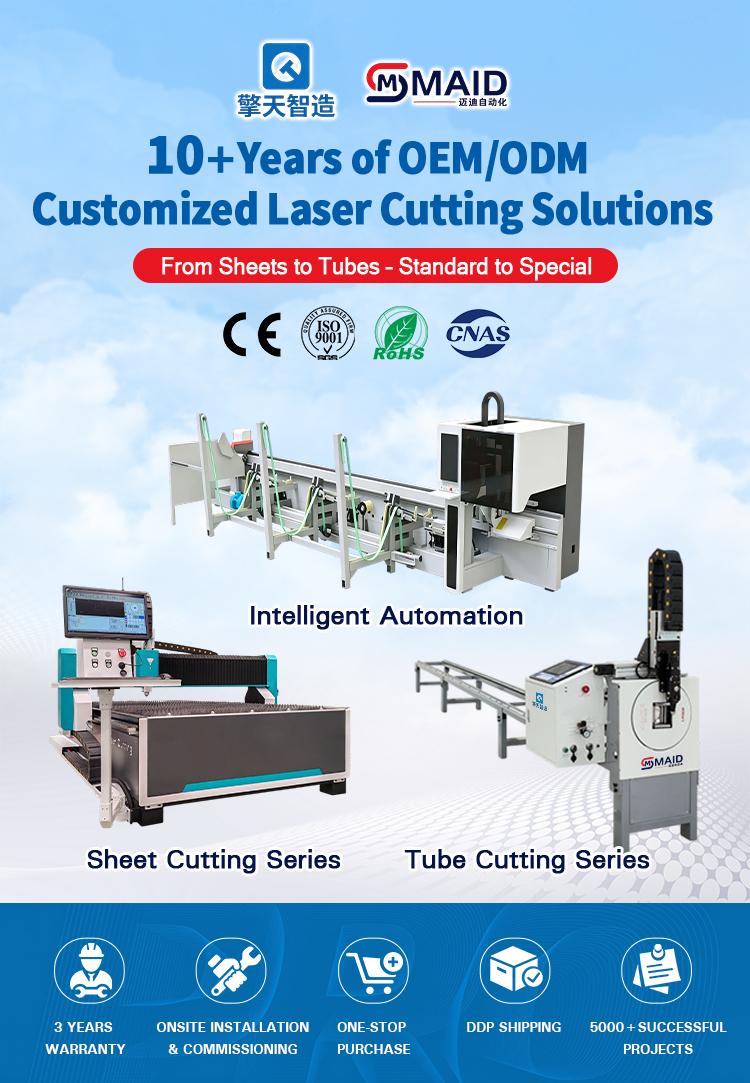
What is an entry-level fiber tube cutting machine: dealers should first clarify what it can cut and what it cannot cut
When a customer asks "what can this machine cut," if you only reply "it can cut tubes," you will most likely end up arguing later. The positioning of an entry-level fiber tube cutting machine must be made clear from the start: it is a fiber laser tube cutting machine that uses a laser to perform 2D cutting, hole drilling, and severing on tubes. It is not a 3D beveling machine, nor is it heavy-duty large-tube blanking equipment. This QingTian mini economical model is equipped with 4 axes and a 1500W fiber laser. It is suitable for metal tubes such as steel, aluminum, stainless steel, and iron, with a cutting thickness of 0–10mm, liquid cooling, continuous wave output, and can operate continuously for long periods.
These are the capability foundations, but what truly determines whether a customer can use it is tube diameter and tube type.
How the mini economical fiber laser tube cutting machine works and the types of processing it performs
Its processing actions can be divided into three categories: severing (cutting the tube to length), hole drilling (making round holes, square holes, etc. in the tube wall), and 2D contour cutting (cutting patterns or special-shaped openings on the tube surface). The suitable jobs are scenarios such as cutting guardrail posts, metal furniture tubes, advertising frames, and stainless steel round and square tubes with small diameters, multiple specifications, and small batches—flexible changeover, with no need to make molds for each specification.
Where are the boundaries for cutting small-diameter round and square tubes?
The first layer of dealer screening gets stuck right on the words "small diameter." If the pipe material a customer brings exceeds the small-diameter range, or requires 3D beveling or intersecting-line cutting, this machine should not be pushed hard. Another boundary is thickness: 0–10mm is the nominal range. How thick it can actually cut and how fast it can cut depend on the material, wall thickness, and drawing complexity. One number cannot cover all materials.
When doing initial screening for customers, first ask three things clearly:
- Pipe type and diameter: Is it round pipe, square pipe, or special-shaped pipe?Does the diameter fall within the small-diameter range?
- Processing content: only cutting off, or do you need hole drilling and contour cutting?Is there any three-dimensional beveling requirement?
- Material and wall thickness: Cutting stainless steel and cutting aluminum perform differently at the same thickness; the closer the wall thickness is to the upper limit, the more cautious you need to be.
Only when all three items fall within the equipment's capabilities can we move on to the next round of discussing power configuration and customization. If any one item is beyond the limit, we must honestly tell the customer that this machine cannot cover it, rather than taking the order first and then trying to find a way.
As for whether the customer's specific batch of pipes can be cut and what the cutting result will be, the pipe type, diameter, wall thickness, material, and processing drawings need to be provided together to the QingTian team for matching and confirmation.
1500 watts, 0-10mm, 7000-8000mm/min: which customer orders can be directly recommended
Putting these three numbers together actually answers the same question: does the customer's tube order fall within the conventional capability range of this machine? For the judgment sequence, it is recommended to first look at thickness, then at cycle time, and finally confirm whether the tube diameter and processing type match the 4-axis structure.
Working backward from tube thickness to power matching: what does 0-10mm cover?
1500 watts paired with 0-10mm covers the conventional cutting scenarios for small-diameter round tubes and square tubes. When applied to specific orders, it can be divided as follows:
- Thin-wall tubes (roughly below 3mm): For orders such as guardrail posts, advertising frames, and metal furniture tube parts, the cutting speed is fast and the cut quality is stable. This is the most comfortable range for this machine and can be directly recommended.
- Medium-to-thick-walled tubes (approximately 3-6mm): Cutting and hole-making of stainless steel round tubes and square tubes can still be done, but if the customer has high requirements for cross-section smoothness, or if the batch is very large, it needs to be stated in advance that the cutting speed will decrease with thickness, and the cycle time cannot be promised at 7000-8000mm/min.
- Approaching 10mm: This is the upper limit of capability, not a daily working condition.Carbon steel is relatively easy to cut, while stainless steel slows down noticeably when approaching the upper limit, and the risk of heat-affected zones and dross adhesion increases.For this type of order, it is recommended to first have the customer provide the material, tube diameter, wall thickness, and cut requirements, and only after the technical side confirms the parameters should the delivery date be quoted.
It should be noted that 0-10mm is the equipment's capability range, which does not mean that all materials can achieve ideal results at 10mm. Different combinations of material (carbon steel/stainless steel/aluminum), tube diameter, and wall thickness will result in different actual performance.
Cycle time assessment: whether 7000-8000mm/min matches the customer's production capacity
7000-8000mm/min is a cutting speed indicator and cannot be directly equated to the customer's production capacity. When converting to actual cycle time, you also need to add rapid traverse, changeover, and loading/unloading time. The assessment method is very simple:
- The customer's daily output is in the tens to hundreds of pieces, with many specifications and small batch sizes — changeover flexibility is more important than extreme speed, and this machine is suitable.
- The customer has a single large batch and requires continuous high-speed cutting — the actual cutting length, number of piercings, and loading/unloading method must all be calculated together to determine whether 7000-8000mm/min is sufficient; you cannot look at this number alone.
- In the customer's orders, the pipe diameter range is wide and specifications are changed frequently — the 4-axis structure is well suited to 2D cutting, hole opening, and cutting off, but changeover time must be included in the cycle time.
Can be recommended directly vs. needs to be confirmed first
Can be directly recommended: Orders for small-diameter round tubes and square tubes, with conventional wall thickness, many specifications and small batch sizes, mainly involving cutting and hole drilling, such as cutting guardrail posts, metal furniture tubes, and advertising frames.
Need to confirm first before recommending: Orders with wall thickness close to 10mm, made of stainless steel and requiring high cross-section quality, with extremely large single batch sizes requiring continuous high speed, or with tube diameters beyond the small-diameter range. For these categories, ask the customer to provide material, tube diameter, wall thickness, daily output, and cutting requirements, and confirm the parameter matching solution with the Qingtian team before replying.
Which customers are suitable for recommendation and which should not be recommended: real suitability judgment for guardrail posts, metal furniture, and advertising frames
Whether it can be recommended does not depend on which industry the customer is in, but on whether the tube specifications and order structure fall withintwo-dimensional cutting, hole drilling, and cutting of small-diameter round tubes and square tubesWithin the scope.
Suitable recommended scenarios: stainless steel round pipe and square pipe cutting, guardrail post blanking, metal furniture pipe processing, advertising frame production
- Guardrail post blanking: Batch blanking requires consistent length and flat cut surfaces, which belongs to small-diameter pipe cutting processing.
- Metal furniture pipe processing: Requires hole drilling and cutting off; the equipment supports three types of processing: 2D cutting, hole drilling, and cutting off.
- Advertising frame production: Pipe specifications are diverse and single-piece customization is frequent, so flexible changeover is more important than extreme speed.
- Stainless steel round pipe and square pipe cutting: Orders have many specifications and small batch sizes, belonging to two-dimensional cutting of small-diameter pipes.
- Startup processing workshop: With limited startup capital and space, one machine is needed to cover multiple types of small-diameter pipes.
The common points of these types of customers are: small pipe diameter, mainly round pipes and square pipes, and processing mainly for hole opening and cutting. When recommending, you can also confirm whether the power and configuration can be customized on demand, and whether installation, commissioning, and operation training are provided.
Boundaries not recommended for recommendation: orders exceeding small-diameter round pipes and square pipes or with thickness exceeding 0-10mm
- Orders exceeding the range of small-diameter round pipes and square pipes: The pipe dimensions exceed the equipment's processing capacity and do not match.
- Orders with thickness beyond 0-10mm: The equipment's cutting thickness is 0-10mm; anything beyond this range is outside its capability.
When encountering these two types of inquiries, do not push hard. If the customer has long been working with thick walls or large pipe diameters, this machine cannot solve their main problem.
Before recommending, first ask clearly about the pipe diameter range and wall thickness: if it falls within small diameter and 0-10mm, the recommendation is valid;if it falls outside the range, honestly explain that it does not match.
Budget boundaries and customization judgment: when to choose a standard configuration, and when it is not worth adding complexity
The 1500W, 4-axis, 0–10mm mini tube cutting machine already covers the cutting, hole punching, and truncation of small-diameter round and square tubes. Before quoting, distributors should first determine whether the customer falls within its capability scope, and then discuss whether to add configurations.
Trade-off signals between standard configuration and power/configuration customization
Signals that standard configuration is usually sufficient: The customer's main tubing is small-diameter round and square tubes, and daily processing consists of cutting, hole punching, and truncation, with no need for 3D beveling or special-shaped cross-sections;There are many order specifications, small batches, and frequent changeovers; what is needed is flexibility rather than extreme speed;Space and startup capital are limited, and the hope is to get running first and then expand.
Situations worth evaluating for customization or upgrades: Customers often cut thicknesses beyond the 0–10mm range, or pipe diameters clearly beyond the small-diameter range—this is a question of whether the equipment configuration matches;Customers require 3D cutting, intersecting line cutting, or beveling, which the 2D equipment structure does not cover;Capacity requirements are high enough to require automatic loading and unloading and multi-chuck linkage, which has entered another product tier.
Situations where adding complexity is not worthwhile: The customer is only adding configurations in advance because they are "afraid it won't be enough in the future," but the current order structure, pipe specifications, and capacity targets have not yet been clearly defined. Customization will lengthen delivery times, raise budgets, and increase debugging and training costs, while the benefits are difficult to realize in the short term. First use a standard configuration to get the main processing running smoothly, and evaluate upgrades once real bottlenecks appear.
List of unknown items that must be confirmed with the product team before recommending
- The cutting capability boundary of 1500W under the customer's actual material and wall thickness combination, especially the speed and cross-section quality when approaching 10mm;
- The compatibility of the Fangling control system with the customer's commonly used graphic formats, and whether it matches the existing layout workflow;
- The installation requirements of the liquid cooling system under the customer's site conditions (water, electricity, space);
- Whether power or configuration customization is supported, as well as the customizable range, lead time, and price impact;
- The specific arrangements for installation, commissioning, and operation training, as well as the response method for subsequent maintenance and spare parts supply.
This information determines whether the quotation can be implemented and whether the customer can smoothly start production after purchase. It is recommended to confirm each item before making promises to the customer.
Frequently Asked Questions
The customer wants to cut 12mm stainless steel pipe. Can this machine be customized to do that? The cutting thickness of the existing configuration is 0–10mm. Going beyond the range is a matter of the equipment's capability boundary. It is necessary to first confirm with the product team whether there is a corresponding solution, and then determine whether it is suitable for recommendation.
The customer's order volume is not large. Should we suggest that they directly go with a higher configuration? If the current order is mainly cutting, hole punching, and truncating small-diameter pipes, the standard configuration is usually sufficient. A higher configuration will bring increased budget, delivery time, and maintenance complexity. It is recommended to evaluate only after a real bottleneck appears.
Will custom power or configuration affect delivery time and price? Yes. The specific extent depends on the customization content. It is necessary to confirm with the product team the customizable scope, delivery time, and quotation, and then explain it to the customer.
Is this machine suitable for customers with no experience with laser equipment at all? The equipment is adjustment-free and maintenance-free, with low accessory costs, making it relatively friendly to entry-level users. However, it is recommended to confirm the training arrangements, the difficulty of getting started with operation, and the after-sales response method with the product provider in advance.
Learn more
If you are evaluating a cutting solution for small-diameter round pipes and square pipes, you can organize the pipe type, diameter, wall thickness, material, and daily processing patterns and submit them to the Qingtian Zhizao team.We will help determine, based on your actual working conditions, whether this mini economical fiber laser pipe cutting machine is a match and whether the configuration needs to be adjusted.