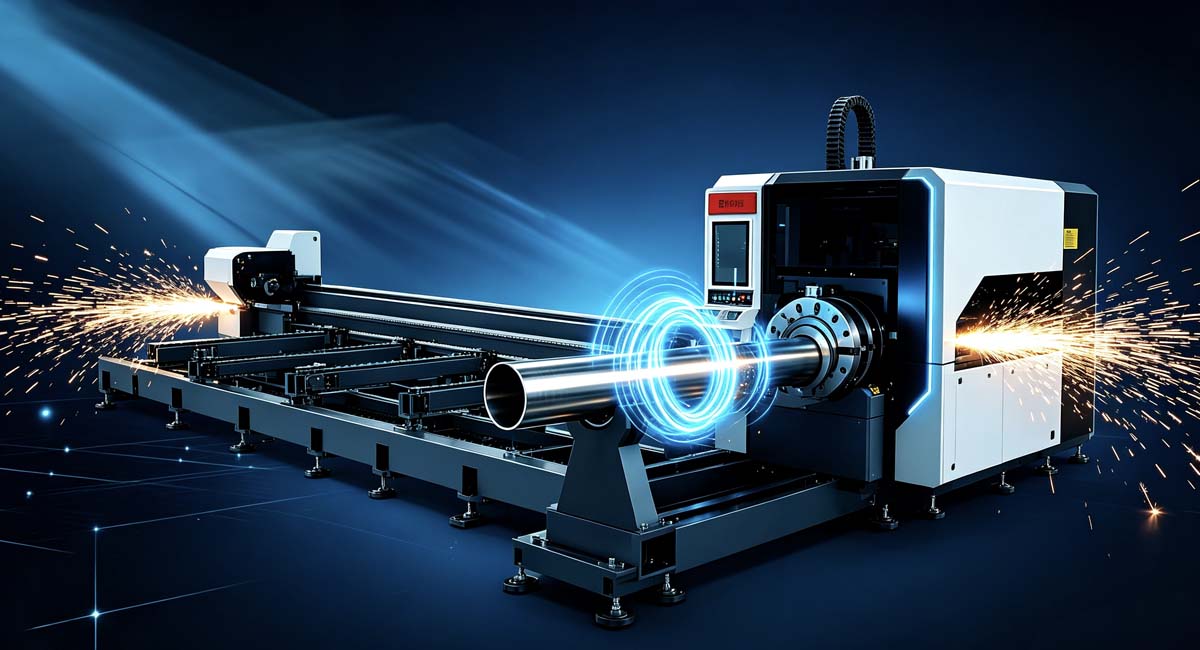
Why can't daily production capacity estimation only consider laser power?
Many purchasers, when selecting equipment, first ask, "How many kilowatts is this?" ”。 Power indeed determines how thick a tube the equipment can cut and how fast, but it is only one variable in the production capacity formula.
What truly determines how many finished tubes you can produce in a day is the entire process cycle time of the machine, from loading the tube material to completing the cutting, and then starting the next tube.
From "Cutting Speed" to "Machine Cycle Time": The True Composition of Production Capacity
The calculation logic for daily production capacity is actually simple:
Daily production capacity = Single tube processing cycle time × Daily effective operating time ÷ Single tube length
Among them, the "single tube processing cycle time" consists of three parts:
- Cutting time: The time required for the laser to complete the cutting path, affected by power, cutting speed, and tube wall thickness.
- Auxiliary time: The time for loading, clamping, positioning, unloading, and material change.This part is often severely underestimated on manual or semi-automatic equipment.
- End scrap loss: After each tube is cut, a section of unusable end scrap remains at the chuck clamping end.The longer the end scrap, the lower the effective utilization rate and the less actual output.
Looking only at laser power is like seeing only the first item while ignoring the other two. For high-volume processing scenarios, auxiliary time and tail-end material loss often widen the capacity gap more than cutting speed does.
Taking the 6012QL-3000W as an example: which parameters directly affect daily output?
Taking the Maidi 6012QL-3000W fully automatic loading laser tube cutting machine as an example, three parameters have the most direct impact on daily output:
Maximum Y-axis speed (150 m/min): The Y-axis is the main motion axis during cutting; the faster the speed, the shorter the cutting time per tube. For production lines that batch-cut tubes of the same specification, this parameter directly determines the upper limit of the cycle time in the cutting stage.
Maximum chuck speed (200 r/min): When circular pipe rotation cutting is involved in pipe cutting, the chuck speed determines how quickly the rotation action is completed. The higher the speed, the shorter the time required for operations such as cutting special-shaped holes and arcs on the round pipe.
Tail length (50mm): This is the parameter most easily overlooked, yet it has a significant impact on cost. Taking a 6-meter pipe as an example, if the tail length is reduced from 100mm to 50mm, the effective usable length of each pipe increases by 50mm. Based on processing 500 pipes per day, this results in an additional 25 meters of usable pipe material per day—equivalent to the material of 4-5 extra whole pipes.
The shorter the tail, the higher the material utilization rate, and the greater the actual output.
How much does fully automatic loading improve production capacity?
Fully automatic loading solves the problem of auxiliary time. Manually loading a 6-meter pipe, from hoisting, positioning, feeding into the chuck to clamping completion, typically takes 2-5 minutes and requires a dedicated operator. The fully automatic loading system of the 6012QL-3000W compresses this process to within tens of seconds, without any manual intervention.
For 24-hour continuous production scenarios, this gap is amplified: manually loaded and unloaded equipment requires 1-2 operators per shift specifically for loading, and operator fatigue leads to unstable cycle times;fully automatic loading equipment, on the other hand, enables truly unattended operation, continuous night shifts, and predictable and stable production capacity.
Core conclusion: When assessing daily production capacity, do not just compare power parameters. First confirm your pipe specifications and batch size, then focus on comparing three sets of data—cutting axis speed, chuck rotation speed, and remnant length—as well as whether the equipment has fully automatic loading and unloading capabilities. If your current processing scenario involves multiple batches and multiple specifications switching every day, the impact of auxiliary time will be greater;If it is continuous production of a single specification in large batches, the impact of cutting speed and tail length is more prominent.
Next, it is recommended that you organize the actual pipe specifications, wall thickness, and daily target output for processing, and confirm with the Maidi team the specific cycle time calculation for the 6012QL-3000W under these conditions.
How to use the parameters of the 6012QL-3000W to estimate the cutting time for a single pipe?
A simplified capacity estimation formula
To estimate the cutting time for a single pipe, the core is to separate the "cutting action" and "auxiliary action". For fully automatic loading equipment like the 6012QL-3000W, the total cycle time for a single pipe can be simplified as:
Total time per pipe ≈ loading/unloading time + cutting time
The cutting time depends on two parameters:Y-axis speed(determines the axial feed rate of the pipe) andchuck rotation speed(determines the rotation speed of the pipe). For round pipe cutting, the cutting path is a combined motion of "rotation + feed", and the actual cutting speed is limited by the slower of the two.
The daily production capacity estimation formula is:
Daily production capacity (pieces) ≈ effective working time ÷ total time per piece
Effective working time is calculated based on the actual operating time of the equipment, typically 20-22 hours (excluding downtime for shift changes, slag removal, material replacement, etc.).
Substituting parameters: a calculation demonstration using a 6-meter-long round pipe as an example
Taking the parameters of the 6012QL-3000W as an example: maximum Y-axis speed is 150 m/min, and maximum chuck speed is 200 r/min. Assume cutting a round pipe 6 meters long and 50 mm in diameter, with a total path of about 6.5 meters for hole cutting and cutting off.
Step 1: Calculate the theoretical cutting time
- Based on Y-axis speed: 6.5 m ÷ 150 m/min ≈ 0.043 min ≈ 2.6 seconds
- Based on chuck speed: cutting one circular path takes about 1/200 min = 0.3 seconds. If the entire 6.5-meter path is rotary cutting, it takes about 6.5 m ÷ (π × 0.05 m) × 0.3 seconds ≈ 12.4 seconds
The actual cutting time takes the larger of the two, approximately 12-15 seconds (including acceleration/deceleration and piercing time).
Step 2: Add loading and unloading time
In fully automatic loading mode, the loading and unloading time is approximately 10-20 seconds per piece, taking 15 seconds.
Step 3: Calculate the total time per piece and daily production capacity
Total time per piece ≈ 15 seconds (cutting) + 15 seconds (loading/unloading) = 30 seconds per piece. Calculated based on 20 hours of effective operating time:
20h × 3600s ÷ 30s ≈ 2400 pieces/day
This is an estimated value under ideal conditions, and actual production capacity will be affected by the following factors:
- Pipe wall thickness and material (thick-walled pipes require reduced speed or increased piercing time)
- Complexity of the cutting pattern (the more holes and the more complex the contour, the lower the actual speed)
- Tail stock length (6012QL tail stock is 50mm, so the actual usable length of a 6-meter pipe is approximately 5.95 meters)
Next step: confirmation action: If you have specific pipe specifications on hand (wall thickness, material, cutting pattern), it is recommended to provide drawings or samples directly to the Maidi team, and let them give a more accurate cycle time based on actual process parameters—this will be closer to your real production capacity than any theoretical estimate.
From theory to practice: which working condition factors will reduce daily production capacity?
Theoretical production capacity is an ideal value calculated based on the equipment's maximum speed and continuous operation at full load. However, in actual production, several factors will continuously lower this figure, and they often occur simultaneously, not simply adding up, but amplifying each other's impact.
Impact of Cutting Pattern Complexity and Material Properties
The more complex the pattern, the further the actual speed deviates from the maximum speed. The equipment's rated maximum Y-axis speed of 150 m/min can only be achieved during idle travel or straight-line cutting. Once the cutting pattern includes dense corners, small arcs, bevel cuts, or irregular holes, the laser head must frequently decelerate, accelerate, and change direction, and the actual cutting speed may only be 30%-60% of the maximum speed.
For example: cutting two round holes on a square tube versus cutting a dozen irregular holes on a square tube—the latter may take 2-3 times longer per tube, even if the tube length is the same.
Material thickness and hardness also directly reduce speed. With 3000W power, the speed advantage is obvious when cutting thin-walled tubes (e.g., 1-2mm), but when cutting materials over 6mm thick or materials like high-carbon steel and stainless steel, the equipment must actively reduce speed to ensure cut quality; otherwise, issues like slag adhesion and rough cross-sections may occur. This means: **when switching between orders of different materials or wall thicknesses within the same day, the average productivity will be lower than when processing only a single type of thin-walled tube.**
**
Unattended does not mean unmanaged: the hidden time of monitoring and maintenance
This machine supports true unattended operation, but "unattended" means the cutting process does not require manual intervention, not that the equipment can be left unmanaged indefinitely. In actual operation, the following types of time must be deducted from the theoretical operating time:
- Regular inspections: At least one person needs to check the cutting status each shift to confirm there are no abnormal alarms, taking about 10-15 minutes per time.
- Consumable replacement: Protective lenses, nozzles, ceramic rings, and other consumables may need to be replaced every shift or every day depending on the cutting volume and material, with each shutdown taking about 5-10 minutes.
- Slag removal and maintenance: The slag generated from cutting needs to be cleaned regularly, and the guide rails and chucks need to be lubricated on a cycle. This time accumulates to about 1-2 hours per week.
- Loading rack replenishment: Although loading is automatic, when the pipes on the rack are used up, manual replenishment is required. The replenishment time depends on the rack capacity and pipe specifications.
When these hidden times are factored in, a machine designed to run 24 hours a day actually has an effective cutting time of about 20-22 hours per day, not 24 hours.
Key to establishing reasonable capacity expectations
When estimating actual daily capacity, it is recommended to correct the theoretical value as follows:
- First calculate theoretical capacity: Calculate based on maximum speed and full load.
- Multiply by the pattern factor: For simple patterns (straight cuts, few holes), use 0.7-0.8;For medium complexity, use 0.5-0.6;For high complexity (dense irregular holes, multiple corners), use 0.3-0.4.
- Multiply by the material factor: For thin-wall carbon steel, use 1.0;For thick-wall or high-hardness materials, use 0.6-0.8.
- Then deduct hidden downtime: Calculated based on 20-22 effective operating hours per day, not 24 hours.
For example, a machine with a theoretical capacity of 1000 pieces/day, when cutting medium-complexity patterns on 4mm stainless steel, the actual capacity is approximately 1000 × 0.55 × 0.7 × 0.88 ≈ 340 pieces/day. This figure is much lower than the theoretical value, but it is closer to the real output.
If your orders mainly involve complex patterns and thick-walled materials, or you plan to run continuously for 24 hours, it is recommended to directly provide the specific pipe specifications, wall thickness, and pattern samples to the Maidi team, and let them calculate the capacity based on actual working conditions, rather than just looking at the maximum speed on the parameter sheet.
How to determine whether the 6012QL-3000W is suitable for you based on daily capacity requirements?
The daily capacity estimated in the previous section is only meaningful when placed in the context of your order structure. The judgment method is simple:Multiply the estimated daily capacity by the actual working days per month to get the monthly capacity range, and then compare it with your monthly order volume.
Assuming you estimate based on 8 hours per day and a material utilization rate of 70%, you get a daily production capacity of approximately X tons (or X meters). Multiplying by 22 working days gives a monthly production capacity of approximately 22X. If your monthly order volume is stable within the range of 80%–110% of this figure, the capacity matching of this equipment is appropriate—it will neither frequently idle nor require long-term overtime to catch up.
Compare the estimated result with your monthly order volume
When making the specific comparison, consider three scenarios:
- Monthly order volume is between 60%–100% of the estimated capacity: Good match. The equipment has surplus capacity to handle temporary additional orders without being idle and wasted.
- Monthly order volume consistently exceeds 120% of the estimated upper limit: This indicates that a single 6012QL-3000W unit may not be sufficient.You need to consider two-shift operation (daily capacity nearly doubles, but labor costs increase), or directly evaluate models with higher power (such as 4000W/6000W) or higher speed.Note that the cutting speed limit of 3000W is a physical bottleneck, and there is limited room for improvement through process optimization.
- Monthly order volume is less than 40% of estimated capacity: The equipment idles most of the time, and depreciation and floor space costs will eat into profits.In this case, the advantages of a fully automatic solution cannot be realized.
In what situations is it recommended to choose a simpler solution?
The value of fully automatic loading and unattended operation is based onUnder the premise of stable batch sizes and relatively uniform pipe specifications,under the premise that. If the following situations match your current status, semi-automatic or traditional cutting solutions may be more economical:
- Frequent switching of order types: If the pipe diameter or length is changed more than 3 times a day, the adjustment time of the fully automatic feeding mechanism will offset the efficiency advantage.
- Small batch quantities: If a batch has only a few dozen pipes, the time proportion of manual loading and unloading is not high, and the savings from automation are not obvious.
- Pipe specifications exceed the equipment range: The 6012QL-3000W supports diameters/side lengths of 10–120mm and lengths ≤6500mm.If your products frequently involve pipe diameters over 120mm or extra-long pipes, this machine is simply not suitable—this isn't a selection issue, it's a capability boundary issue.
- Budget-sensitive with uncertain order growth: The procurement and maintenance costs of fully automatic solutions are significantly higher than semi-automatic ones.If the order volume for the next 12 months is unclear, starting with semi-automatic and upgrading later makes risk more controllable.
Clear recommendation boundaries: For scaled processing enterprises with stable monthly orders, pipe specifications within the parameter range, and a desire to reduce reliance on manual labor, the 6012QL-3000W is a suitable choice;For scenarios with fluctuating orders, frequent specification changes, or long-term monthly capacity needs exceeding 120% of the single-unit limit, directly adopting a fully automatic solution is not recommended.
If you are unsure whether your monthly order volume is tight or loose for this machine, organize the following information:Typical pipe specifications, total monthly tonnage, working days per month, and planned operating hours per day—and hand it to the Maidi team for a capacity matching calculation, which will be more accurate than your own estimate.
Frequently Asked Questions
Q: If the monthly capacity demand exceeds the estimated upper limit, is the only option to switch to a higher-power machine? Not necessarily. First, determine whether your capacity bottleneck is cutting speed or loading/unloading time.
If loading and unloading take up a lot of time, adding auxiliary equipment or optimizing the rack layout may be more cost-effective than switching to higher power. If cutting speed itself is the bottleneck, then you need to consider a higher-power model.
Q: Our product types change frequently. Will fully automatic loading actually slow down production? Yes. The fully automatic loading mechanism requires adjustment time when switching between different pipe diameters, and this time accumulates with frequent switching.
If your order structure is 'small batch, many varieties,' the manual flexibility of semi-automatic equipment is actually higher.
Q: The tail end length of this equipment is 50mm. Does it have a significant impact on my material utilization rate? It depends on the unit price of your pipe material and whether the tail end can be reused. If the pipe material cost is high and the tail end cannot be spliced for reuse, a 50mm tail end means a fixed length loss for each pipe.
The larger the batch, the more worthwhile it is to include this loss in cost accounting.
Q: If my current order volume is small, but I expect it to grow next year, how should I choose? It is recommended to base your decision on the expected monthly order volume for next year, rather than the current one. If next year's expectation can reach more than 60% of the equipment's capacity, purchasing now allows you to debug the production line in advance;If growth is uncertain, it is safer to first use leasing or outsourced processing as a transition, and purchase after orders stabilize.
Learn More
If you are evaluating the transition from manual feeding to unattended operation, it is recommended to first organize the typical pipe specifications, wall thickness, monthly order volume, and planned daily operating hours.Provide this information to the Maidi team, and we can conduct a targeted capacity matching calculation based on the actual process parameters of the 6012QL-3000W, helping you determine whether this equipment suits your production pace.
Related Products:6012QL-3000W Automatic Feeding Laser Tube Cutting Machine