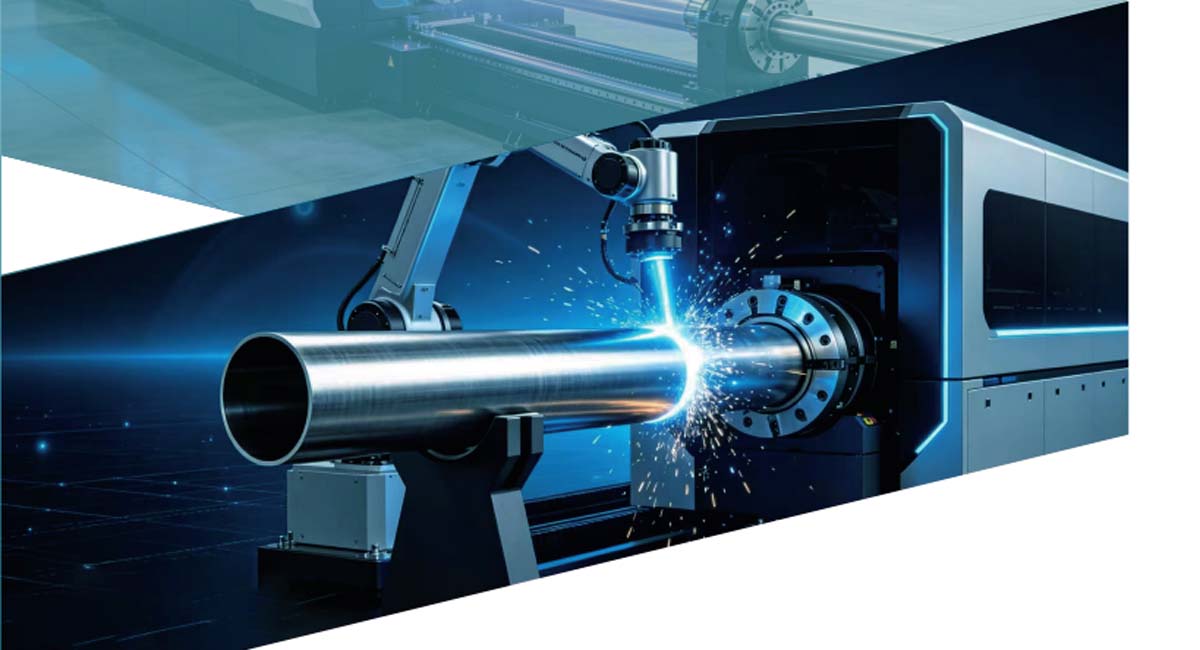
As the manufacturing industry accelerates its transformation toward high-end and intelligent production, the laser tube cutting machine has emerged as a revolutionary piece of equipment in the field of pipe and tube processing. It is profoundly changing production methods across multiple sectors. From automotive manufacturing to aerospace, from furniture production to building steel structures, the application landscape of tube laser cutting machines continues to expand, becoming a key driver of industrial upgrading.
Automotive Manufacturing: Breakthroughs in Precision and Efficiency
The automotive industry is one of the most important application areas for fiber laser tube cutters. Against the backdrop of rapid growth in new energy vehicles, components such as battery pack brackets, cooling pipes, exhaust systems, and chassis structural parts demand extremely high processing accuracy for tubes. For example, battery pack brackets require cutting aluminum alloy tubes with thicknesses of 1 to 3 millimeters, with precision controlled within plus or minus 0.02 millimeters to avoid welding stress concentration. Laser tube cutting machines, with their non-contact processing, smooth burr-free cuts, and ability to handle complex shapes, have become the critical solution to these challenges. After introducing a tube laser cutting machine, one new energy vehicle piping supplier increased material utilization from 82 percent to 97 percent, boosted single-shift production from 80 pieces to 300 pieces, and shortened order delivery cycles by 50 percent.
The Preferred Solution Under Stringent Standards
The aerospace sector imposes even stricter requirements on equipment. In the processing of aircraft components, titanium alloy hydraulic tubes require cutting accuracy of 0.02 millimeters and the ability to perform bevel cutting on curved surfaces. High-strength materials such as stainless steel, titanium alloys, and composite materials account for over 60 percent of aerospace tube applications. Traditional cutting methods struggle to handle these materials, often causing deformation and large heat-affected zones. The non-contact nature and extremely high precision of laser tube cutting machines make them the preferred choice for aerospace tube processing.
Furniture Industry: From Multi‑Step Processes to Integrated Smart Manufacturing
The furniture manufacturing industry also benefits significantly from the adoption of tube laser cutting technology. A well-known brand uses high-power laser tube cutting machines to process stainless steel handrails. Previously, a bent tube required five separate processes; now, with a single positioning, the machine can complete cutting, hole opening, and engraving, reducing the processing time per piece from 45 minutes to just 8 minutes. Fully automated production follows pre-designed patterns, eliminating human cutting errors, ensuring consistent quality, producing smooth and burr-free edges, and increasing productivity by more than three times.
Construction and Hardware: Broad Demands and One‑Stop Supply
The construction and hardware processing industries also extensively use tube cutting equipment. From guardrails, handrails, to building steel structures, the demand for cutting square tubes, round tubes, and rectangular tubes continues to grow. QINGTIAN, operating under Qingtian Intelligent Manufacturing, serves as a one-stop CNC cutting equipment supplier. Its product range covers 12 main models, handling pipe diameters from 10 millimeters to 240 millimeters and laser power from 1500 watts to 3000 watts. The company employs advanced fiber laser and plasma cutting technologies, supported by professional R&D and quality inspection teams. It strictly adheres to industry standards to ensure every machine meets high-performance and high-stability requirements. Serving industries including hardware, machinery, construction, and automotive manufacturing, QINGTIAN provides comprehensive services for global pipe and sheet metal processing enterprises, covering everything from equipment customization to after-sales support.
Cross‑Industry Applications and Future Outlook
In addition, the oil and gas industry uses tube laser cutting machines for pipeline fabrication, while the agricultural machinery sector relies on them for producing durable tubular frames. The versatility of the laser tube cutter makes it indispensable for modern fabrication shops. As manufacturing continues to evolve, the demand for efficient, precise, and flexible tube processing solutions will only increase, solidifying the position of tube laser cutting machines as essential tools for competitive production.